
There are few pains as disorienting and deep as the ache in a mother’s heart when something is wrong with her child. It might be rebellion, suffering, illness, distance, silence, or choices you never imagined they would make. Whatever the source of the pain, it can make you feel like your heart is walking around outside your body—vulnerable, exposed, and hurting in ways that are hard to put into words.
If that’s where you are, you are not alone. And more importantly, you are not without hope. God meets people in the middle of real, honest suffering. He does not ask you to pretend this doesn’t hurt. He invites you to bring the full weight of your breaking heart to him.
Naming the Pain Honestly
One of the most compassionate things Scripture does is give language to sorrow. The Psalms are filled with cries that echo what many mothers feel: How long, O Lord? Why is this happening? Where are you?
A breaking heart often carries multiple layers: grief, fear, guilt, anger, confusion—even shame. You may wonder,
- Did I do something wrong?
- Why can’t I fix this?
- What will happen to my child?
These questions are not signs of weak faith. They are the honest questions of a loving heart. Faith does not rush you past your questions. Instead, it helps you bring them into the presence of God. Psalm 62:8 says, “Pour out your heart before him; God is a refuge for us.” That means nothing in your heart is unwelcome.
When You Feel Powerless
As mothers, we desire to protect, guide, and nurture. So when something is beyond our control, it can feel unbearable. You may replay conversations, second-guess decisions, or try to find the one thing that will make everything better.
But here is a hard and freeing truth: You were never meant to be your child’s savior. Only Jesus holds that role. This is a hard truth because we often want to fix everything so that our child is okay. But it is also a freeing truth because it means that the weight of our child’s troubles is not on our shoulders. We cannot control our child’s life; we can only control our own responses and entrust our child to the Lord as we wrestle with how to respond wisely.
This doesn’t minimize your love or your responsibility—it puts your responsibility and your hope in the right place. Your child’s life is ultimately in God’s hands, not yours. That reality can feel terrifying at first, but it is also deeply relieving. God is more attentive, wiser, and more powerful than you could ever be.
Isaiah 49:15 offers a stunning picture: Even if a mother could forget her nursing child (which is nearly unthinkable), God says, “I will not forget you.” If he holds you with that kind of care, he is certainly able to hold your child as well.
Sorting Through Guilt and Responsibility
When a child struggles, many mothers instinctively turn inward: Where did I fail?
Sometimes there are things to acknowledge. No parent loves perfectly. There may be words you wish you could take back or moments you wish you had handled differently. Wisdom encourages humble reflection where appropriate. But it also guards against false guilt.
Your child is not a simple equation where perfect parenting guarantees perfect outcomes. Scripture presents a more complex and realistic view of the human heart. Each person responds to God in ways that are not entirely determined by their upbringing. That means you can
- confess where you have sinned,
- seek forgiveness where needed,
- release what was never yours to control, and
- trust a loving God who holds your child’s life in his hands.
Romans 8:1 reminds us, “There is therefore now no condemnation for those who are in Christ Jesus.” That includes you in your motherhood.
Holding on to Hope When You Can’t See Change
One of the hardest parts of a breaking heart is the waiting. You pray, you hope, you long for change—and nothing seems to happen. Or worse, things seem to get harder.
In these moments, hope is not wishful thinking. It is anchored in who God is, not in how quickly circumstances change. God is present (Psalm 34:18: “The Lord is near to the brokenhearted.”), active (even when unseen), and faithful (he does not abandon his work).
Sometimes his work in your child’s life is slow, hidden, and unfolding in ways you cannot trace. Sometimes his work in your heart is just as important—deepening your dependence, reshaping your prayers, and drawing you closer to him. Hope grows not by controlling outcomes, but by returning again and again to God’s character.
When your heart is breaking, turning to God in prayer is essential, but it can be difficult. You may not know what to say. Words may fail. That’s okay. Romans 8:26 tells us that “the Spirit helps us in our weakness,” even “interced[ing] for us with groanings too deep for words.” You can pray simple prayers like these:
- “Lord, help my child.”
- “Give me wisdom.”
- “Sustain me today.”
- “Do what only you can do.”
When you don’t have strength, you can borrow the words of Scripture. The Psalms become a lifeline, giving you language when your own runs dry. And even your tears themselves are a kind of prayer.
Don’t Carry It Alone
A breaking heart can be isolating. You may feel like others don’t understand, or you may hesitate to share because of fear or embarrassment. But God does not intend for you to carry your heartache alone. Galatians 6:2 calls us to “bear one another’s burdens.” That might look like talking with a trusted friend, seeking wise counsel, or inviting someone to pray with you regularly.
Wise counselors don’t offer quick fixes. They listen, weep with you, and gently point you to the source of all hope.
When everything feels uncertain, what can you hold on to? Not a guaranteed outcome.
Not a timeline for change. Not your ability to fix things. You hold on to a Person.
Jesus is described as a “man of sorrows and acquainted with grief” (Isaiah 53:3). That means he understands suffering from the inside. He is not distant from your pain—he enters into it. And more than that, he has overcome sin and death itself. That means no situation is beyond his redeeming power. Your story—and your child’s story—is still being written.
If your heart is breaking today, consider this not as a call to “be stronger,” but as an invitation: Come as you are. Bring your questions. Bring your fears. Bring your love for your child. There is a faithful God available to you.
God is not asking you to have it all together. He is inviting you to draw near to him in the middle of the mess.
And as you do, you may find something surprising—not that the pain immediately disappears, but that you are no longer alone in it.
The God who sees, who knows, and who cares is holding both you and your child.
Even here, there is hope.
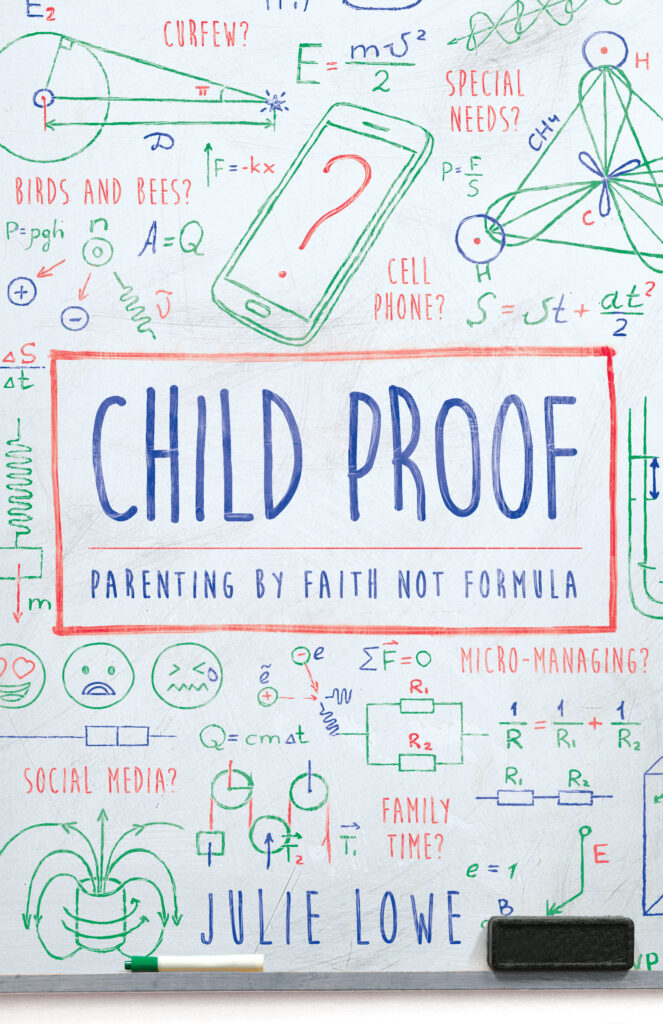
CHILD PROOF: PARENTING BY FAITH, NOT FORMULA
As a freedom-over-formula parenting book for moms, dads, and caregivers of all ages, Child Proof by Julie Lowe provides biblical insight and encouragement for readers who want to parent by faith.