
Have you noticed that trying to managing time well in our modern world often resembles a disorienting trip through the twilight time zone? If you’re like us, you want to wisely invest your life and time in your work and your relationships. But, at the same time, you feel the sting of real life struggles in real time. When something falls through the cracks, you miss an important assignment, or you realize you just don’t have enough time to do it all, that sting makes you question whether you’re going at it the best way. You’re not alone.
Time works the same way for all of us. We must learn to use time as a commodity of love, not simply as something we get to spend. Learning the difference means careful time management is an art and not a science. Realizing this shifts our mindset from focusing on efficiency to focusing on effectiveness, care, and what matters most in life. Our deepest aspiration should not be to spend time like we would a paycheck, but to consider ways our time might be best used for love and good deeds (Hebrews 10:24).
In this art of wise time management, we all see time differently. Each of us sees time as a context for what we care about most. If you ask most people how to manage time better, they will talk about calendars and to-do lists. Those things certainly have their place. But underneath every method for managing time sits a question that matters more than any productivity system ever will: What and who do you love (Mark 12:30–33)?
When considered rightly, time serves us as a context for love, not simply as a resource to spend. Ask ten different people how they see their time, and you will likely get ten different answers, because every person perceives time through the lens of what they love most.
But before you can love well with your time, you have to believe you are loved (1 John 4:19). Puritan pastor Walter Marshall put it plainly: “You cannot love God if you are under the continual secret suspicion that he is really your enemy.” Marshall goes on: “We must be first persuaded of the love of God in Christ to us, before we can love God again with a holy love.” God’s sovereign, wise, and good orchestration of our lives stands as a central truth of time management. To cheerfully put our time to best use, we must first be assured that God joins us in the stewardship of our lives. He gives blessing to our efforts and wisdom for the difficult decisions of time management. Without this truth operating at the heart of our dealings with time, we will struggle to cheerfully handle time.
This is why so many people burn out trying to manage their time well. If you have a wrong view of God, suspecting he is harsh, distant, or impossible to please, you will lose the joy of directing your time (1 John 4:18). You might hoard it defensively or spend it anxiously. But if we maintain a right view of God and his love for us in Christ, we find freedom to pour out our lives in courageous stewardship.
Martin Luther called this “the common order of Christian love”—the ordinary, God-given structures through which we express love in daily life. “The Christian’s worship is to serve the neighbor through love in the common order of daily life,” Luther wrote. “God does not need your good works, but your neighbor does.” Your calendar is not first a logistics problem. It’s the place where love either does or doesn’t show up (Galatians 5:13–14).
Shepherding time well is not about doing more, becoming better, or impressing the people around you with what you can accomplish. Instead, it’s about engaging in the timely moments of your life with a settled desire to love God, to know the joy of living for his purposes, and to help the people around you do the same.
That is the ruling question underneath every calendar, every to-do list, every planning system you’ll ever try: not “How do I get more done?” but “How do I love well with what I’ve been given?” Answer that question rightly, and the rest of time management tends to follow.
Let us pull it all together under the heading of one simple truth: you were loved before you ever accomplished anything (Romans 5:8). That love doesn’t hang on how much you get done today. Once you believe that, your time changes shape. You stop managing minutes to prove your worth and start spending them to love God and the people in front of you. That’s the whole aim of shepherding time well. It’s not about more output, but a life poured out in love, because you know the one who first poured his love into you. Answer that question rightly, and everything else falls into place (Romans 5:5).
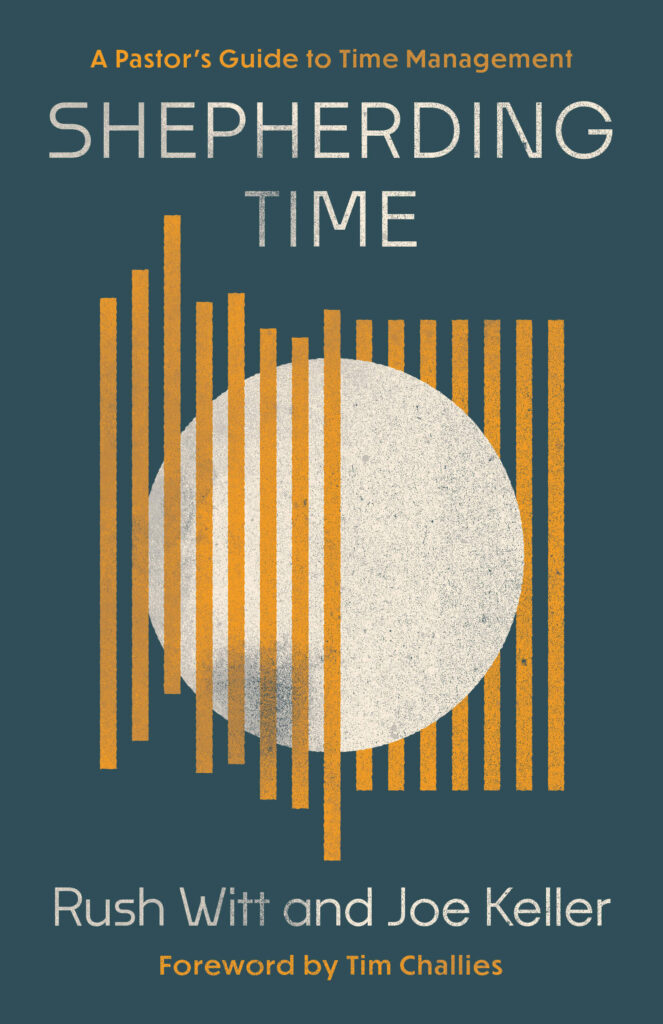
Shepherding TIme
Time is a precious and finite commodity. Are you stewarding it well? As a pastor, your work moves fluidly between study and solitude, counseling and crisis care, administration and leadership, plus a series of daily interruptions, not to mention your family and home life. How do you manage time effectively in a role without predictable hours, where you encounter the needs of others at every turn? Rush Witt and Joe Keller show pastors how to think biblically about time, diagnose common struggles, and build sustainable rhythms for long-term faithfulness and joy in their calling.