
Brave New World. 1984. The Giver. The Hunger Games. Divergent.
These are just a few of the notable novels that come to mind when I think of cultural commentary dressed as dystopian drama. Each story speaks to something true about character, human development, and the ills of society. But each also paints a sinister, unsettling future. This essay is not a critique of these authors or their books. For example, I read Brave New World in a single sitting and enjoyed it. Every one of these writers is immensely gifted. Their stories have their place and can even be helpful.
My quarrel is not with these books. It is with our over-consumption of such media. A warning read once can inoculate us; a steady diet of dread disciples us in an unhealthy way. And too much dark vision, taken in long enough, dims the soul.
Our culture is saturated in dystopian nihilism. Every few years a fresh existential threat comes along: one more reason to cower and abandon any dream of a meaningful future.
Unfortunately, like every human, Christians are susceptible to fear and doubt. But this should not be the way of those who place their hope in the love of God and the work of Jesus Christ.
Fortunately, Jesus has told us how to abide in love and how to hold on to hope. Listen to what he says in Matthew 6:22 (NIV 2008):
“The eye is the lamp of the body. If your eyes are good, your whole body will be full of light.”
What we behold, we become. Attention is never neutral: It trains belief, and belief drives our behavior. Surrender your eyes to darkness long enough and, as Jesus warns, the whole body will be filled with it:
“If your eyes are bad, your whole body will be full of darkness. If then the light within you is darkness, how great is the darkness!”
This darkness shapes how we view the future and what we work toward: Tell a generation the future is a cage, and they may just build it.
Les Misérables. Crime and Punishment. A Christmas Carol.
Like the books that launched this essay, these works do not shy away from hard realities, tragedy, and suffering. But they, and others like them, offer a redemptive arc that is resonant with the gospel message. Jesus does not promise us absence of pain or trouble. He offers us Presence throughout our lives and throughout history. Our sure hope relies on this truth. As one of the great storytellers of the last century, J. R. R. Tolkien, told another, C. S. Lewis, the ancient myths of dying-and-rising gods were forever compelling because they are forever true. Behind them all stands the one true myth become fact: a God who joined humanity, endured its hardships, suffered, died, and rose again, and so conquered fear and darkness forever.
We still have a choice. We can surrender to algorithmic programming that feeds our basest fears and foibles. Or we can focus our attention on the good, the true, and the beautiful. Our future and our children’s future depend on it.
And yet, the negativity is ubiquitous. How can we be wise in the face of it?
I’ve found the following three questions to be a great help when I choose what to read. These questions, asked after a few chapters of a book, help me protect my eyes, and thus my life. If you suffer from the malady that says, “Finish every book you start,” may I encourage you to reconsider? Try these three questions as you read a new book and perhaps you’ll keep the light from dimming in you:
1. What do the characters notice?
This is a question about the way characters are oriented and thus the way they reflect the world of their story back to the reader. Do the characters end exchanges with biting quips or bitter retorts? Do they notice a shine to the world, or are they drawn to point out only the bad stuff?
2. What does suffering produce in this world?
Is there a Christ-like endurance that yields beauty and grace, or is all suffering just random bad fortune with no meaning or point?
3. Is there a character who inspires me?
This may take a few chapters to sort out, but at some point there should be a character who embodies the hope and joy that we all carry as we walk with Jesus. If not, close the book!
So fill the lamp. Choose the stories that train your eyes to hunt for light—in Jean Valjean’s mercy in Les Misérables, in Rodion Raskolnikov’s confession in Crime and Punishment, and in Ebenezer Scrooge’s second chance in A Christmas Carol. Fill your children’s eyes the same way, and their children’s after them.
The God who became human, endured, suffered, died, and rose again has already conquered fear and darkness forever; the least his people can do is stop feeding on the dark. Flood your eyes with light, until body and soul are kindled with faith, hope, and love. Enough dystopia already.
Godspeed as you read!
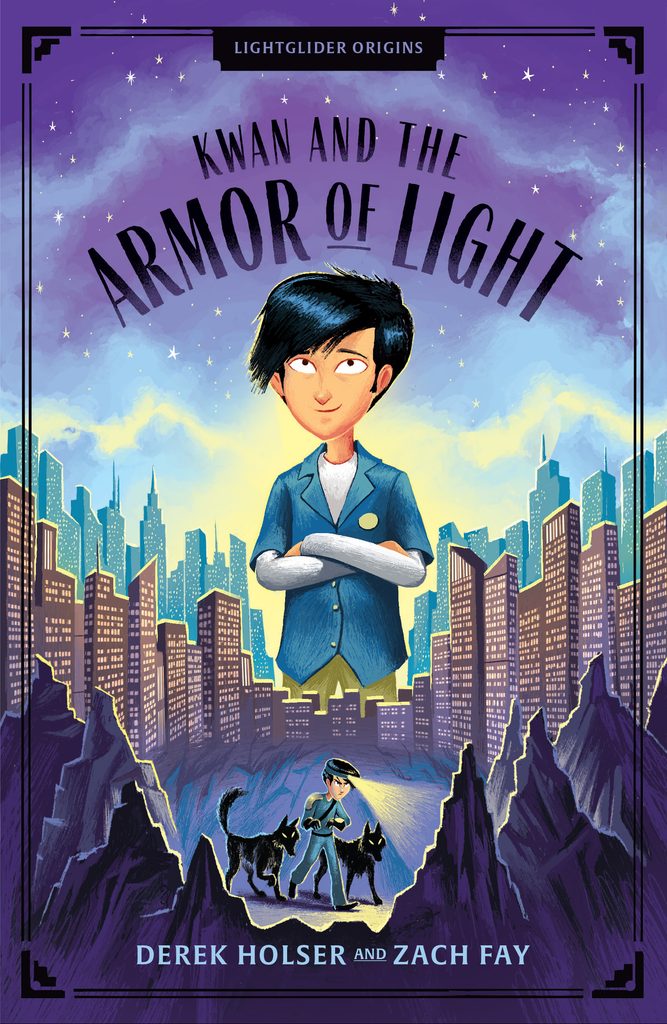
Kwan and the Armor of Light
Kwan longs to make a difference and is desperate to protect his family’s legacy. As the son of the Chief Technology Integration Minister, the stakes are high to prove his worth. After achieving prominence for discovering a revolutionary compound for building roads and bridges, Kwan realizes that his compound might be toxic. Should he speak up to protect the environment of his homeland, or follow professional success and recognition? In the back of his mind, he remembers the advice his father once gave him: Sometimes secrets are necessary.