
Because the media doesn’t report the spread of the good news across town and around the globe, it’s easy for Christians to be unaware of the incredible work God is actively doing today. The same God who turned the world upside down two thousand years ago is still changing lives and communities today.The gospel continues to spread and transform lives across cultures and contexts today, just as it did in the early church.
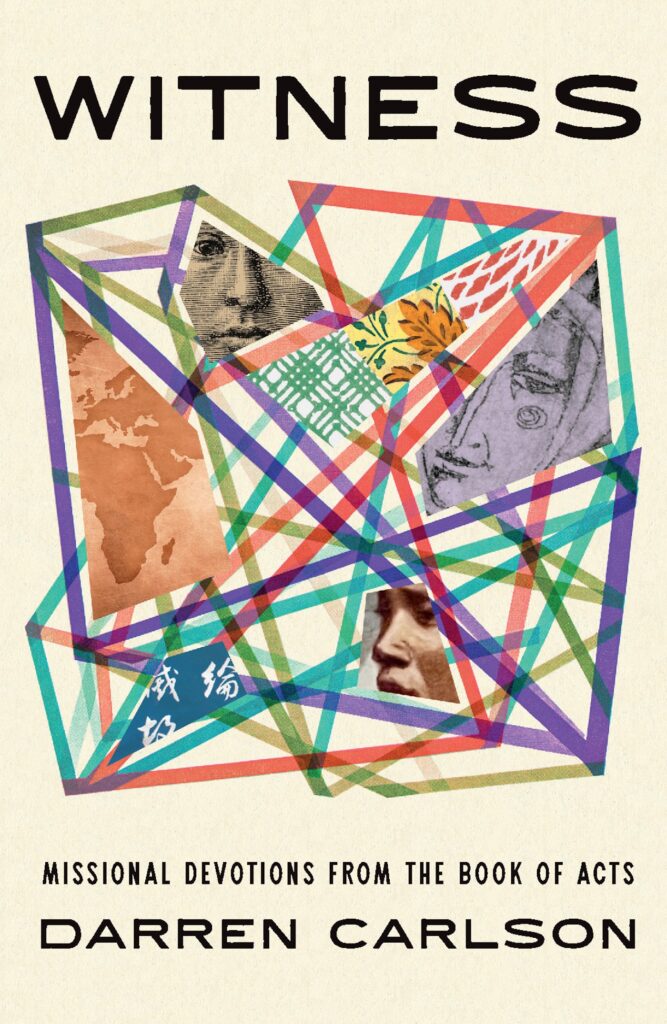
In his sixty-day devotional, Witness: Missional Devotionals from the Book of Acts, Darren Carlson shares the stories of modern-day Christians and draws parallels to the experiences of first-century Christians in the book of Acts, giving readers a virtual world tour of God’s work both near and far.
Q: You write that we are living in one of the greatest times of gospel advancement in history. Why do you say that?
I say that because it is statistically true—and it’s surprising when you stop and picture it. Imagine telling Korean believers a hundred years ago, when Christianity was only 1–2% of the population, that Korea would become one of the most Christian nations on earth. Or imagine telling a Chinese believer in the early 1950s—part of a tiny, pressured minority with no cultural power—that China would one day have the largest church in Asia. Tell the four known Mongolian Christians in 1989 that there would be thousands within a few decades. Or tell the 22 million Christians in Asia in 1990 that within 30 years there would be something like 300 million. The scale of growth is simply staggering.
When you zoom out globally, the story is hard to miss: the center of gravity in Christianity has shifted decisively. Places once labeled “the mission field” have become centers of vibrant, multiplying church life—especially across Africa, Asia, and parts of Latin America. In many of these contexts, the church isn’t growing because it’s culturally convenient; it’s growing because the gospel is powerful, believers are resilient, and the Spirit is building what no government, ideology, or pressure campaign can ultimately stop.
What strikes me most is how often that growth follows the contours of Acts. The church advances through ordinary people, persistent prayer, costly obedience, and courageous witness—often in hardship, opposition, and marginalization. That pattern shouldn’t surprise us. Acts never presents the mission as easy; it presents it as unstoppable, because Jesus is alive and reigning.
Q: What is the main message you hope readers walk away with from reading Witness?
More than anything, I want to encourage the saints and widen their sense of what God is doing in the world right now. Many believers feel discouraged by cultural shifts, worn down by the news cycle, or tempted to think the best days of gospel fruit are behind us. Witness is meant to push back on that despair with something sturdier than optimism: the reality that Jesus is alive, reigning, and actively building His church.
My hope is that readers come away freshly convinced that God still loves to work through ordinary people empowered by the Holy Spirit. Acts is not primarily a story about spiritual superheroes; it’s a story about the risen Christ working through weak vessels. If readers finish the book with greater confidence in Christ, deeper love for His people around the world, and renewed courage to bear witness in their own lives, then it has accomplished what I most want it to do.
Q: How did you gather the stories of the modern church used in the book? Are some of them your personal stories?
The stories were gathered the way many of the best stories are gathered: through relationships. Over years of conversations, shared ministry, and partnership with believers and leaders in different contexts, you begin to see themes repeat—what faith looks like when it’s costly, how churches take root, how leaders are formed, how the gospel moves along relational lines, and how the Spirit sustains people when circumstances don’t. Some accounts come from firsthand experiences; others are stories I’ve been entrusted with by friends who are living and laboring in places most of us will never see.
Some are my personal stories, but even those are rarely “my” stories in the spotlight sense. They’re usually stories of what I observed in others. One of the burdens of the book is to help readers realize that the modern church is not a distant abstraction. It is full of real people—pastors, students, mothers, refugees, workers—who are living the same Christian life we read about in Acts, just in different languages, settings, and pressures.
Q: How have your personal experiences in global missions shaped the stories and reflections in Witness?
My work has kept these reflections from drifting into theory. This is real life on life stuff! When you’ve sat with believers who count the cost more concretely than you do, or watched a church gather with fewer resources but greater urgency, you start to see what’s essential. You also start to notice how easily we can confuse comfort with health, and influence with faithfulness—mistakes Acts simply won’t let us make.
Those experiences have also changed how I read Acts itself. The themes that can feel distant on a first read—boldness, suffering, prayer, dependence on the Spirit—suddenly feel very near. You realize that Acts is not romanticizing hardship; it’s normalizing the pattern of cross before crown, weakness before strength, and witness before vindication. I also try to hold in tension the miraculous and the ordinary, just like in Acts, from Peter getting broken out of jail to Paul being stuck in jail for two years.
Q: What has been the most challenging moment in your missions journey, and how did you see God at work through it?
One of the most consistently challenging moments in missions isn’t dramatic—it’s is overwhelming joy and as well as a slow heartbreak knowing how little you can “fix.” You meet faithful believers carrying heavy burdens: displacement, persecution pressure, family rejection, unstable economies, chronic insecurity. You pray, you listen, you try to serve wisely—and you realize how small you are. That kind of ministry exposes both your limitations and your temptations: to control outcomes, to measure fruit too quickly, or to subtly place hope in strategy rather than in God.
I’ve seen prayers answered in ways no one could have engineered: doors opening for gospel witness, leaders raised up from unlikely places, endurance given when strength ran out, reconciliation where bitterness seemed inevitable. The clearest evidence of God’s work is often not a headline moment, but steady faithfulness: believers forgiving enemies, continuing to gather, continuing to proclaim Jesus, continuing to hope. That kind of perseverance is not natural—it is supernatural grace.
Q: Could you share one of your favorite stories from the book?
I love how my Eritrean friends came to Christ, started a church as refugees, and then planted churches throughout Europe. And while there are many stories that are extraordinary, one of my favorite kinds of stories in Witness is when you see Acts-like “ordinary faithfulness” become the pathway for extraordinary gospel fruit—simple hospitality, Scripture shared, a prayer offered, a relationship patiently maintained, a believer who refuses to be ashamed of Christ. Those stories matter because they correct the myth that the Spirit only works through the spectacular. In Acts and today, yes, there are miracles—but there is also a relentless emphasis on preaching, prayer, presence, and perseverance.
I love those stories because they restore courage to normal Christians. They help people see that obedience on a Tuesday matters; that consistency matters; that sowing matters even when you don’t see immediate results. And they remind us that God delights to use what looks small to the world. The “favorite story” isn’t always the most dramatic—it’s often the one that makes you say, “I can do that. By the Spirit’s help, I can be faithful where I am.”
Q: What can the modern church learn from the early church as seen in the book of Acts?
Acts teaches us that the church grows through Spirit-empowered witness, not through cultural privilege, ideal circumstances, or political protection. The early Christians were devoted to prayer, Scripture, community, and mission—and they expected opposition as part of faithful discipleship. Their courage wasn’t personality-driven; it was produced by confidence in the risen Christ and the presence of the Holy Spirit. They didn’t wait for the world to become receptive; they bore witness because Jesus is Lord.
The modern church needs that same simplicity and that same steel. We need deep dependence on God instead of dependence on platforms. We need churches that prize faithfulness over flash, prayer over panic, and gospel clarity over vague spirituality. Acts also teaches us to hold suffering and joy together: the church can be opposed and flourishing at the same time. When we recover those priorities—Word, prayer, community, mission—we stop being surprised by hardship and start being ready for fruit.
Q: We don’t always think much about Luke’s narrative of Jesus’s ascension from Earth, but you write of its significance. Would you share about the importance of this event?
The ascension means Jesus didn’t simply depart—He was enthroned. It’s the declaration that the crucified and risen Christ now reigns as King, and that He continues His work through His people. In Acts, the mission doesn’t begin because the disciples finally get brave; it begins because the King has taken His throne and poured out His Spirit. The ascension anchors mission in authority: we witness not because we feel strong or the culture is receptive, but because Christ rules.
It also reframes suffering, delays, and setbacks. If Jesus is enthroned, then history is not spinning; it is governed. The church’s trials are not evidence that God has lost control—they are often the very means by which the gospel advances. The ascension gives the church confidence, patience, and courage: confidence that Jesus reigns, patience that His kingdom is advancing on His timetable, and courage to bear witness even when it costs us.
Q: How do you see the themes of Acts such as boldness, suffering, and the power of the Holy Spirit playing out in the global church today?
Across the global church, you still see Spirit-given boldness, often from believers with little social power but deep confidence in Christ. Many Christians around the world don’t have cultural leverage; they have Jesus—and that changes how you speak. Boldness in Acts isn’t loudness; it’s clarity and courage rooted in the resurrection. You see that same posture today: believers speaking plainly about Christ, refusing to be ashamed, and doing so with humility and love.
Suffering remains real, and in many places it is not theoretical—it’s immediate. But the Spirit’s power is evident not only in growth; it’s evident in faithfulness. You see believers persevering, forgiving enemies, praying persistently, discipling patiently, raising leaders, planting churches, and holding fast to hope. Acts is full of ordinary Christians strengthened to endure and to speak. That is exactly what you see again and again: the Spirit sustaining witness, and Christ building His church through it.
Q: What are some practical ways Christians can support the global church and engage in missions, even if they aren’t called to go overseas? How should we pray for the global church?
You can support the global church through informed prayer, sustained giving, and long-term partnership with healthy, locally-led ministries—not just one-time moments. A huge step is simply paying attention: learn names, places, and needs; follow trustworthy ministry partners; listen to global voices rather than assuming we already know what “they need.” Support that respects local leadership strengthens the church rather than unintentionally making it dependent.
And we should pray like Acts teaches us to pray—not mainly for ease, but for faithfulness and fruit. Get the Operation World app and pray for the country of the day! Pray for boldness to speak, wisdom for leaders, unity in churches, protection from temptation, endurance under pressure, and open doors for the gospel. Pray for training and discipleship, for faithful Bible teaching, for the raising up of elders, for the strengthening of families, and for conversions that lead to mature churches. If we pray that way—and give and partner in line with those prayers—we’re not spectators. We’re participants.
Q: How can local churches better equip their members to live missionally in their own communities?
Local churches equip people missionally by making witness normal and accessible: training members to share the gospel simply, to practice intentional hospitality, and to see everyday life as their ministry context. That means helping people connect “church life” to real life—workplaces, neighborhoods, kids’ activities, friendships, and daily rhythms. It also means giving people a vision for the long game: not merely quick conversations, but patient relationships where love and truth can be seen and heard over time.
Churches can also tell better stories and celebrate the right victories. If we only highlight big events, people assume mission is for the unusually gifted. But if we celebrate quiet faithfulness—someone praying with a coworker, inviting a neighbor to dinner, patiently loving a difficult family member, sharing Christ with humility—then people learn what obedience looks like on a Tuesday. Over time, that forms a culture where the whole body sees itself as sent, and where mission becomes a shared way of life rather than a special program.
Witness
As readers dive into the book of Acts, they will be challenged to look for ways God wants them to grow as his ambassadors and develop a deeper appreciation of the unity and diversity of the global Church. Each day’s devotion includes a passage from Acts, a reflection on its significance, and a modern-day story that connects the biblical text to contemporary experiences.