There is a lot of talk about wonder these days. How can we reawaken wonder in today’s generation of kids? How might time in nature ignite wonder inside us? Does wonder have anything to do with faith? And what can we do if we lose our sense of wonder?
These are valid questions, but how often do we stop to consider what wonder is? As we define wonder, we can find where it fits in our lives and how it can nurture resilient faith—not only in the next generation, but in ourselves also.
Whether you’re a parent wanting to nurture wonder in your child, a grandparent asking how to help your grandchild unplug from devices and plug back into nature, or you’re aching to return to the wonder of your own childhood days spent outside, we can find answers to these questions as we discover God’s vision for wonder.
Wonder Slows Us Down
Job 37:14 says, “Hear this, O Job; stop and consider the wondrous works of God.” The book of Job is rich with nature narratives. Between hardship and hard-pressed hope, Job is reminded that the God who spoke the universe into place is still active in his creation. And here in chapter 37 Job is reminded to stop and consider God’s wondrous works. How often do we do the same? As we create habits of slowing—and stopping—we can appreciate God’s works in creation. Wonder, then, requires us to slow down and notice—perhaps that’s wonder’s first gift to us.
The Hebrew word in Job 37:14 translated as “wondrous” is pālā’. Along with wondrous it has been translated as marvelous and extraordinary. It can mean a miracle or an act of God—something far beyond human power, and that’s certainly true of God’s acts in creation. Human technologies and inventions can take inspiration from God’s designs and even mimic them, but they don’t come close to the mastery of our Creator, and they certainly weren’t spoken into being.
The next time you’re walking outside, practice pausing when something grabs your attention. Whether it’s a flower, tree, beetle, or rabbit, stop and consider God’s wondrous works.
Wonder Leads Us to Worship
To wonder, in the biblical sense, is to think about God doing what only God can do. We sense the magnitude of his creativity as we stand beneath a canopy of trees, surrounded by mountain summits, or listening to ocean waves. Wonder sparks worship within us as we magnify God for all he has made—things to provide for us like crops and natural materials—and things simply to wow us like fifty-foot giant squid and axolotls with wavy gills and silly smiles.
It’s not only the exotic and stand-out marvels of nature that ignite wonder in us. Every “common” creature in our own yard can turn our hearts and minds to our Creator. Philippians 4:8 reminds us to think upon everything good, beautiful, noble, and true. Nature gives us that opportunity each day. Whether we step outside for five minutes to feel the sun on our skin, take a walk around the block, enjoy a nearby trail, or embark on a grand adventure in the outdoors—every moment in nature helps us to take our thoughts captive and develop a mindset rooted in everything good, beautiful, and true, resulting in worship for our Creator.
Wonder Shows Us Wisdom
As you practice stopping and considering God’s wondrous works in nature, you’ll hone a habit of glimpsing his wisdom. Psalm 104:24 says, “O Lord, how manifold are your works! In wisdom have you made them all; the earth is full of your creatures.” Everything God made reflects his divine wisdom (yes—even skunks and spiders).
Wisdom is not tangible. We cannot hold it or see it, and yet we can glimpse the products of God’s wisdom in every honeybee, maple leaf, and garden snail.
Romans 1:20 tells us, “For his invisible attributes, namely, his eternal power and divine nature, have been clearly perceived, ever since the creation of the world, in the things that have been made. So they are without excuse.”
The attributes of God we cannot directly see—including his wisdom—can clearly be perceived in what he has made. As we contemplate God’s wisdom, we ourselves become wiser. Proverbs 9:10 says, “The fear of the Lord is the beginning of wisdom, and the knowledge of the Holy One is insight.” “Fear” in this verse means to respect. Whether you’re standing beside a waterfall enjoying its refreshing mist, watching a monarch butterfly deposit eggs on milkweed plants, or enjoying a finch’s morning chorus, you can become wise as you experience the gifts of our wise Creator.
This is why we’re instructed in Proverbs 6:6 to “watch the ants.” Ants showcase for us incredible teamwork in their colony as they dig elaborate underground tunnels, care for their young, and store up food for hard times. But where does the intelligence of an ant come from? Its wise Creator who engineered it with instincts and know-how. Watching ants is a noble activity, and children seem to know this best of all.
Wonder Makes Us Childlike
Jesus spoke of childlike faith in Matthew 8:13 when he said, “Truly, I say to you, unless you turn and become like children, you will never enter the kingdom of heaven.” Childlike faith is faith with a sense of wonder—an innate knowing that the God of the universe is the very best inventor, that he made everything bright and beautiful and yet he cares about us, his children. As we hold onto—or come back to—a childlike faith, we understand that the One who spoke the cosmos into place and holds all things in creation together (Colossians 1:16–17) also holds together the details of our lives. That’s something to wonder at.
Wonder Leads us to Jesus
Where might wonder lead you? Where might it lead the children in your life? As we follow where wonder leads, we’re reminded to slow down, worship, glimpse God’s wisdom and become wiser ourselves, and preserve a childlike faith. Perhaps this is why many natural historians—the very first scientists—long spoke about the “two books of God:” his book of Scripture, and his book of nature.
Scripture is primary as it shows us God’s beautiful gospel—the good news of our salvation. But because God is generous, he gives us more revelations of himself. We can better understand the truths in his Scripture as we glimpse his goodness and wisdom in every beetle and bird. As we follow where wonder leads, we’ll find ourselves with deeper faith, wisdom for life, and a heart full of worship.
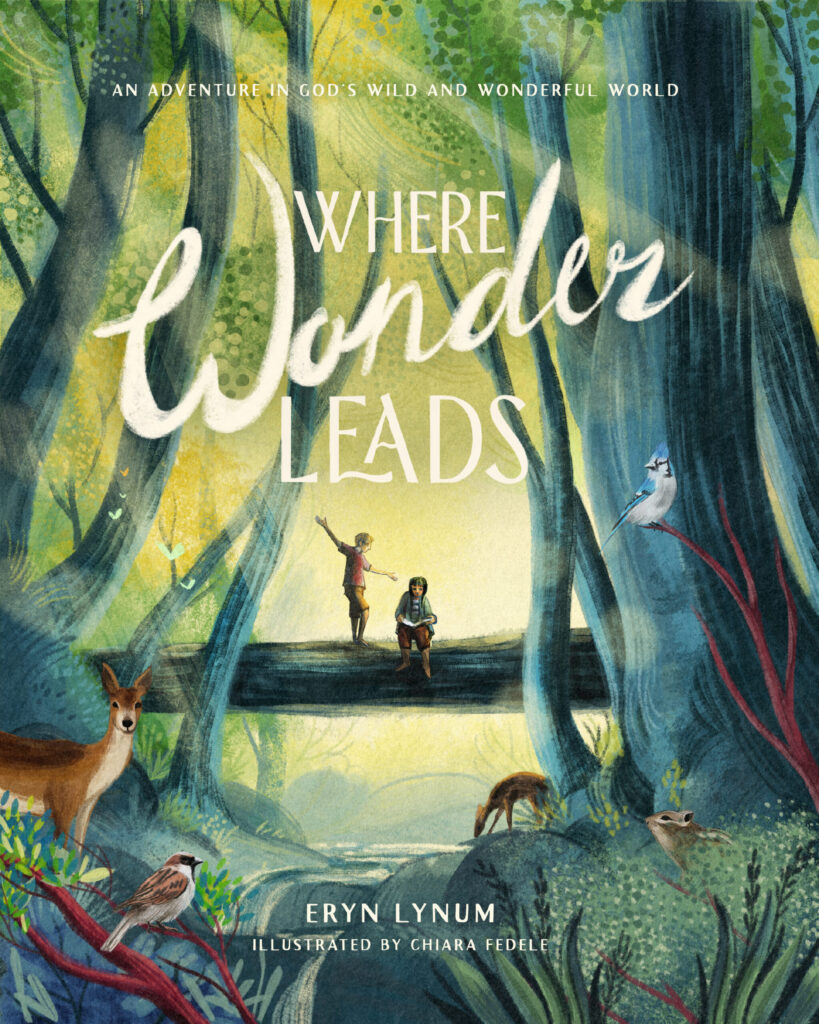
Where Wonder Leads
Master naturalist and Nat Theo host Eryn Lynum guides young readers on a wonder-filled journey to explore God’s creation. Where Wonder Leads blends storytelling, science, and biblical reflection to nurture curiosity about nature. Willow’s story introduces kids to marvelous creatures, plants, and natural phenomena, complete with detailed scientific explanations. Each chapter includes a key scripture and an opportunity to dig deeper into faith and scientific applications. Throughout the story, scientific terms are introduced to grow one’s understanding of God’s intricate designs.