Who Is God?: 52 Pictures to Share with Your Family invites families to get to know God better through fifty-two devotions and pictures that display his power, characteristics, and names. Devotions written by Kate Hox are paired with illustrations by Joe Hox to present families with a big view of God, who is the same yesterday, today, and forever. Following the same format as the couple’s popular Who Is Jesus? devotional, readers will meet the Mighty Creator, the Almighty, and the Ancient of Days. They will learn how he dwells with his people, forgives and carries away our sins, and disciplines those he loves. Families will see that he is amazing, wise, peace, and in control.
Stories are shared chronologically from both the Old and New Testaments to show readers how all Scripture is connected and what it reveals about God from beginning to end. Each devotion includes a captivating illustration, a key verse to remember, Bible passages for reference, reflection questions, and song suggestions.
In this interview with Kate Hox, we learn more about her family devotional.
Q: Introduce us to your new family devotional, Who Is God? Why were you initially hesitant to write this book?
Who Is God? takes readers a journey through the Bible to discover who God is through 52 readings and images. Families will discover attributes of God, names of God, and pictures of God—such as God is our Rock, God is a potter, and God is a Mighty Warrior. They will also trace themes like kingdom, covenant, gardens, and rainbows.
I wrote this book because readers of Who Is Jesus? wanted more. They liked the depth of the devotionals and connections throughout Scripture, so they began asking if I would write another one. In fact, many people asked if I was planning on doing the whole Trinity—one on the Father, then one on the Spirit. Soon our publisher asked the same question. I was really hesitant because our first book had taken us years. Could I do it again and within a shorter time frame? Was I really qualified to write about who God is? There’s truly no greater or more important topic, and I didn’t want to mess it up. Plus, I haven’t been to seminary—I’m just a mom who loves to study the Bible! I didn’t want to write this book unless I was sure I could do it well.
So, I began doing tons of research. I read as many books on the attributes and names of God as I could find, and I also dug into systematic and biblical theology books. I created a giant outline full of ideas, and as I kept digging, I started to get really excited.
Q: Was Who Is God? written for a certain age range of children or can families with both younger and older children still read it together?
I think kids anywhere from age five on up through teenagers and adults can enjoy this devotional. The stories should appeal to all ages, and the older kids and adults will enjoy the connections throughout Scripture. Reflection questions are also included to allow you to go deeper if you wish. Each day has several questions of varying depth, so you can pick the ones that best fit the ages of your kids. My hope is that this book serves large families well, and it’s one that families will want to pull out year after year. The illustrations are appealing to all ages as they are not babyish or cartoony, but rather feel real, rooted, and timeless.
With our first book, many adults have said they enjoyed reading it on their own, and I hope that is true for this Who Is God? as well. Sometimes a grandparent will buy one of our books for their grandkids, and later they’ll come back to buy a copy to keep for themself!
Q: What are the elements included with each day’s devotional? How long does it take to read through the devotional each day?
Each day’s devotional takes about five minutes to read. There is a key verse for each day as well as references to the Bible passages the story is taken from if you’d like to read those too. Each day also includes reflection questions—some more aimed at comprehension, and others that require some deeper thought or further reading. I’m hoping these various levels of questions help serve a variety of families. Possible answers to most questions are included in the back, along with song suggestions for each day.
On my website I have links to all the songs, so you can sing along or simply have it playing in the background as you clean the table and do dishes (that’s what we often do)! There are flashcards you can download and print for each day, featuring Joe’s artwork. These have been very popular among homeschool families. You can use them to review the word pictures, make a Bible timeline, or even play a game. Hopefully, the repetition of the cards will help kids remember the word pictures, and help them spot them in the Bible.
Q: How do you suggest for families to read the book? A chapter every day or once a week since there are fifty-two chapters?
However you’d like! You can absolutely read one every day, or you can just read it every Sunday for a year. If you wanted to, you could spend time the rest of the week reading the corresponding Scripture passages and working your way through the questions. We have heard that many homeschoolers have used Who Is Jesus? in this way.
Q: How does your family come together to create a rhythm for family devotionals?
This is something I love talking about. Our family has chosen to have a time of family worship every evening after dinner. We read a Bible passage or devotional, discuss it a little, sometimes sing a hymn or Scripture memory song, and then we pray. Each of our four kids has a day of the week assigned to them to pray, and Joe and I take Friday through Sunday. Our kids honestly look forward to it, and if we skip it, they are disappointed. So much great conversation happens during this time.
Are there days we skip? Of course. Maybe we’re eating quickly before a recital or soccer practice, or we’re not all together because someone has musical practice. But we try to do it as often as we can. While it’s gotten a little trickier as our kids have gotten older, we still make it a priority. If someone in the family is gone for a meal, we have the other kids catch them up the next evening. It gives those kids a chance to repeat what they learned or share an insight or discussion, which increases their comprehension and enforces the importance of what we do during family worship time.
Q: Was it difficult to come up with fifty-two characteristics and names of God or was it difficult to narrow them down?
At first, I thought it would be difficult, but I soon learned I was very wrong! I did tons of reading and research for this book, and I created a giant outline full of ideas. It was really tricky to narrow it down, and to decide where chronologically to introduce certain attributes. And lots of attributes of God overlap with his names, so I had to choose, for example, to pick God Almighty, God Is All Powerful, or God Omnipotent. And what story do I match it with? There were so many decisions. I also didn’t want to repeat too many stories or ideas from Who Is Jesus?, but some stories, like the creation and the fall, are essential. I eventually narrowed it down to a list of 60, and I wrote 60 devotionals. Our publisher decided to narrow it down to 52. That was hard too!
Q: What are some of the descriptions of God that might be considered more unique or less common?
I chose “God of Order” as one of my two creation stories. I want kids to see how the creation itself was orderly, and that God loves order. He is not a God of chaos or confusion, but rather he brings order out of chaos. When Adam and Eve sinned, chaos entered the world, but God promises to bring order once again.
“God of Rainbows” not only tells the story of the flood, but also how God sits on a throne surrounded by rainbows, as John tells us in the book of Revelation.
Another example might be one titled, “God Makes Dry Bones Come Alive” about Ezekiel’s vision of the valley of dry bones. This is such a powerful image for kids to grasp. Death is not the end! God will make our dry bones come alive.
Not many children’s story Bibles teach about Job or the prophets. The title for Job’s story is “God Is Beyond Comprehension,” and Joe drew the moment where Job says, “I am unworthy—how can I reply to you? I put my hand over my mouth.” What a powerful and memorable image. Hosea’s story, “God Is Like a Faithful Husband,” depicts Hosea’s pain, love, and tenderness, pointing us to our faithful God.
Q: Joe is a terrific illustrator, but did he find any of the attributes difficult to translate into in picture form? Can you share more about the process of working together on the book?
There were a few that were a struggle. For “God Is Holy,” I told the story of Isaiah’s vision of God’s throne room in Isaiah chapter 6, where it says “the train of his robe filled the temple with glory.” What does God’s robe look like? How do you make it fill the temple while still showing that it’s in a temple and not just a big mess of cloth? What does God’s temple look like? We don’t have the answers to all these questions, so some things need to be imagined. He spent a lot of time making changes with that one.
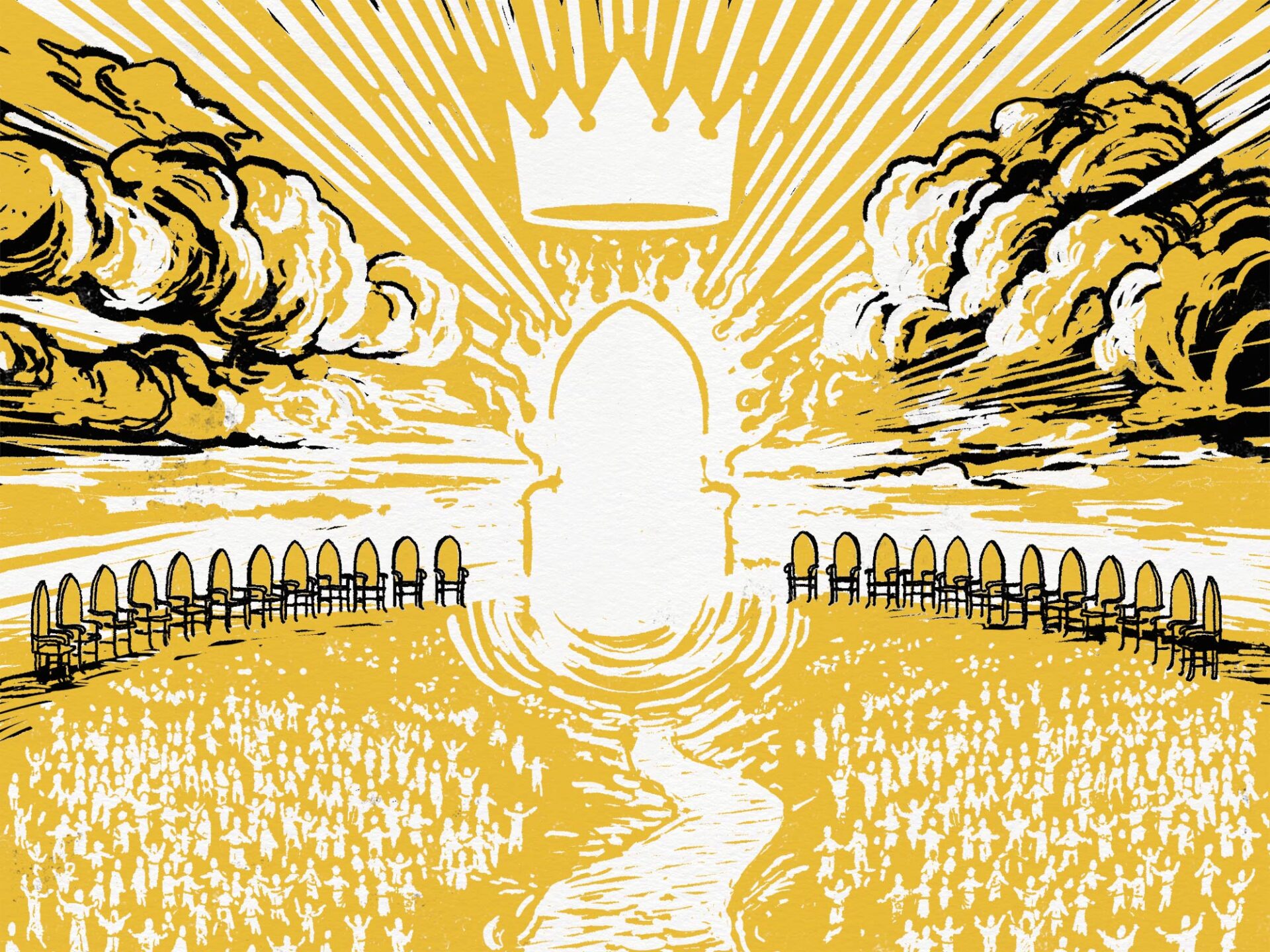
Another difficult one was “God Is the Ancient of Days” from Daniel chapter 7. Daniel sees God, the Ancient of Days, taking his seat in his courtroom. Obviously, Joe was not going to try to depict God, but you also don’t want the throne to look empty. The text also says the throne has wheels, but we didn’t want kids to think that God is in a wheelchair! And it’s flaming with fire, and there’s a river of fire—which is potentially scary—plus there are more thrones and many angels. That image was terribly difficult. He worked with it for days.
Q: How did you balance theological depth while still making the book accessible for children?
Kids love stories—they latch onto them—and of course we have the pictures. So I start with the story, and then I go deep—and I think the kids can easily handle it. Kids are smart! They can handle more than we often give them credit for.
For example, in “God Is Our Rock,” and I tell the story of David fleeing from Saul and finding refuge in the rocks. God is a fortress for him, a protector, like the rocks. That alone is a great lesson, but the rocks also teach us that God is unchanging. Saul was completely unpredictable—loving him one day and wanting to kill him the next. David couldn’t trust him. But God was unchanging. He was always with him, always faithful, always kind. The illustration shows the wind blowing outside the cave, and David is safe inside. God is his rock, his unchanging, faithful God, his protector.
Q: What are some of your favorite chapters? What did you learn about God in the process of writing the book?
I think each time I read through it, a different one is my favorite. God speaks through his Word, and sometimes a story will hit you differently one day than it did a month or two ago.
I absolutely love Joe’s illustration of the prodigal son with his father (“God Redeems and Restores”). I learned a lot in researching the historical background of Jewish families living together in the father’s house and how shocking it would be to a Jewish audience for a son to ask his father for his share of the estate. He wasn’t just taking from his father, but from the whole family, and he was basically telling his father “I wish you were dead.” It was a very shameful thing to do to the entire family, and the whole community would have agreed that the father should disown his son. But he didn’t! He welcomed him back, redeemed him, and restored him to his house. What a beautiful picture this is of how God celebrates us when we repent and return to him. He welcomes us with open arms, and restores the relationship. That’s a reminder we all need on a daily basis.
Overall, the process of writing this book reminded me once again that there is so much to discover in God’s Word. We will never reach the end of what there is to learn about God; there’s always more! True students of the Word of God never grow bored.
Q: What do you hope for families reading Who Is God? together?
I hope that families will learn and grow together and deepen their love for the Lord. The Bible has so much for us to discover! I hope my book makes kids more excited about the Bible, and more eager to learn and discover truths about God through his Word on their own.
I also hope that it will get kids in the habit of asking, “What does this story reveal to me about God?” rather than “What does this verse mean to you?” The focus should not be on ourselves but on our great God. This book will hopefully train them to ask that question and keep that focus as they read their Bibles on their own.
And I hope many children (and adults!) come to Christ through our books. I’ve already heard stories of children who came to Christ reading our first book around the dinner table. I’ve heard about Sunday school classes and entire churches reading it together, sparking great conversations between the older and younger generations. I’ve seen it used in Christian schools. And I’ve heard about it being used on the mission field. Even if our book is just one tiny part of someone’s faith journey, it is such a privilege to be part of that story. Truly, what a joy it is. To God be the glory.
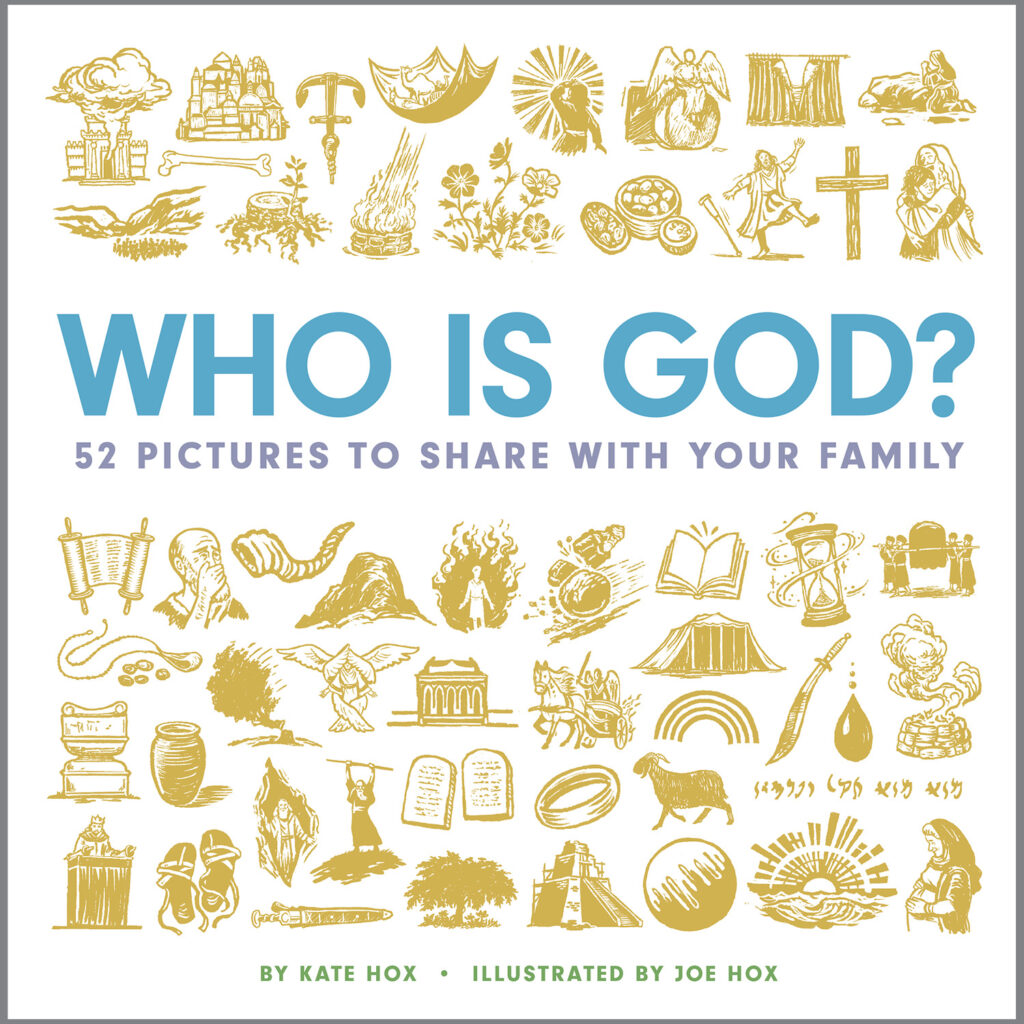
Who Is God?
Who Is God? invites families to get to know God better through fifty-two devotions and pictures that display his attributes, characteristics, and names. Devotions written by Kate Hox are paired with illustrations by Joe Hox to present families with a big view of God, who is the same yesterday, today, and forever. Each devotion includes a captivating illustration, a key verse to remember, Bible passages for reference, reflection questions, and song suggestions.