And about the ninth hour Jesus cried out with a loud voice, saying, “Eli, Eli, lema sabachthani?” that is, “My God, my God, why have you forsaken me?”
Matthew 27:46
I think I can understand the words, “My God, my God, why have you forsaken me?” as they are written by David in the twenty-second Psalm; but the same words, “My God, my God, why have you forsaken me?” when uttered by Jesus on the cross, I cannot comprehend, so I shall not pretend to be able to explain them. There is no plummet that can fathom this deep; there is no eagle’s eye that can penetrate the mystery that surrounds this strange question. I feel more like one who has looked into a deep mine—or like one who has been part of the way down, and shuddered as he passed through the murky darkness but who would not dare to go much lower. For this cry, “Eli, Eli, lema sabachthani?” is a tremendous deep; no man will ever be able to fathom it.
Jesus was accustomed to address God as his Father. If you turn to his many prayers, you will find him almost invariably—if not invariably—speaking to God as his Father. And, truly, he stands in that relationship both as God and as man. Yet, in this instance, he does not say, “Father;” but “My God, my God.” Was it that he had any doubt about his sonship? Assuredly not; Satan had assailed him in the wilderness with the insinuation, “If you are the Son of God,” but Christ had put him to the rout; and I feel persuaded that Satan had not gained any advantage over him, even on the cross, which could have made him doubt whether he was the Son of God or not.
I think that our Savior was speaking then as man, and that this is the reason why he cried, “My God, my God,” rather than “My Father.” I think he must have been speaking as man; as I can scarcely bring my mind to the point of conceiving that God the Son could say to God the Father, “My God, my God.” There is such a wonderful blending of the human and the Divine in the person of the Lord Jesus Christ that, though it may not be absolutely accurate to ascribe to the Deity some things in the life of Christ, yet is he so completely God and man that, often, Scripture does speak of things that must belong to the humanity only as if they belonged to the Godhead. For instance, in his charge to the Ephesian elders, the apostle Paul said, “care for the church of God, which he obtained with his own blood” (Acts 20:28)—an incorrect expression, if judged according to the rule of the logician; but accurate enough according to the scrip-tural method of using words in their proper sense. Yet I do think that we must draw a distinction between the Divinity and the humanity here. As the Lord Jesus said, “My God, my God,” it was because it was his humanity that was mainly to be considered just then.
And O my brethren, does it not show us what a real man, the Christ of God was, that he could be for-saken of his God? We might have supposed that, Christ being Emmanuel—God with us—the Godhead and the manhood being indissolubly united in one person, it would have been impossible for him to be forsaken of God. We might also have inferred, for the same reason, that it would have been impossible for him to have been scourged, and spit upon, and especially that it would not have been possible for him to die. Yet all these things were made, not only possible, but also sacredly certain. In order to complete the redemption of his chosen people, it was necessary for him to be both God’s well-beloved Son, and to be forsaken of his Father; he could truly say, as his saints also have sometimes had to say, “My God, my God, why have you forsaken me!” Persecuted and forsaken believer, behold your Brother in adversity!
But what was this forsaking? We are trying to come a little closer to this burning yet unconsumed bush—with our shoes off our feet, I hope, all the while—and in this spirit we ask, “What was this forsaking?” Christ made no mistake about this matter, for God had forsaken him. It was really so. When he said, “Why have you forsaken me?” he spoke infallible truth, and his mind was under no cloud whatsoever. He knew what he was saying, and he was right in what he said, for his Father had forsaken him for the time.
What, then, can this expression mean? Does it mean that God did not love his Son? O beloved, let us, with the utmost detestation, fling away any suspicion of the kind that we may have harbored! God did forsake his Son, but he loved him as much when he forsook him as at any other period. I even venture to say that, if it had been possible for God’s love towards his Son to be increased, he would have delighted in him more when he was standing as the suffering representative of his chosen people than ever he had delighted in him before. We do not indulge, for a single moment, the thought that God was angry with him personally, or looked upon him as unworthy of his love, or regarded him as one upon whom he could not smile, because of anything displeasing in himself; yet the fact remains that God had forsaken him, for Christ was under no mistake about that matter. He rightly felt that his Father had withdrawn the comfortable light of his countenance, that he had, for the time being, lost the sense of his Father’s favor—not the favor itself, but the consciousness of that divine aid and succor which he had formerly enjoyed—so he felt himself like a man left all alone; and he was not only left all alone by his friends, but also by his God.
After all, beloved, the only solution of the mystery is this, Jesus Christ was forsaken of God because we deserved to be forsaken of God. He was there, on the cross, in our room, and place, and stead; and as the sin-ner, by reason of his sin deserves not to enjoy the favor of God, so Jesus Christ, standing in the place of the sinner, and enduring that which would vindicate the justice of God, had to come under the cloud, as the sinner must have come, if Christ had not taken his place. But, then, since he has come under it, let us recollect that he was thus left of God that you and I, who believe in him, might never be left of God. Since he, for a little while, was separated from his Father, we may boldly cry, “Who shall separate us from the love of Christ?” (Romans 8:35) and, with the apostle Paul, we may confidently affirm that nothing in the whole universe shall be able to separate us from the love of God, which is in Christ Jesus our Lord (Romans 8:39).
Excerpted from What Depth of Love by Charles H. Spurgeon © 2026 by Geoff Chang (editor). Used with permission of New Growth Press. May not be reproduced without prior written permission.
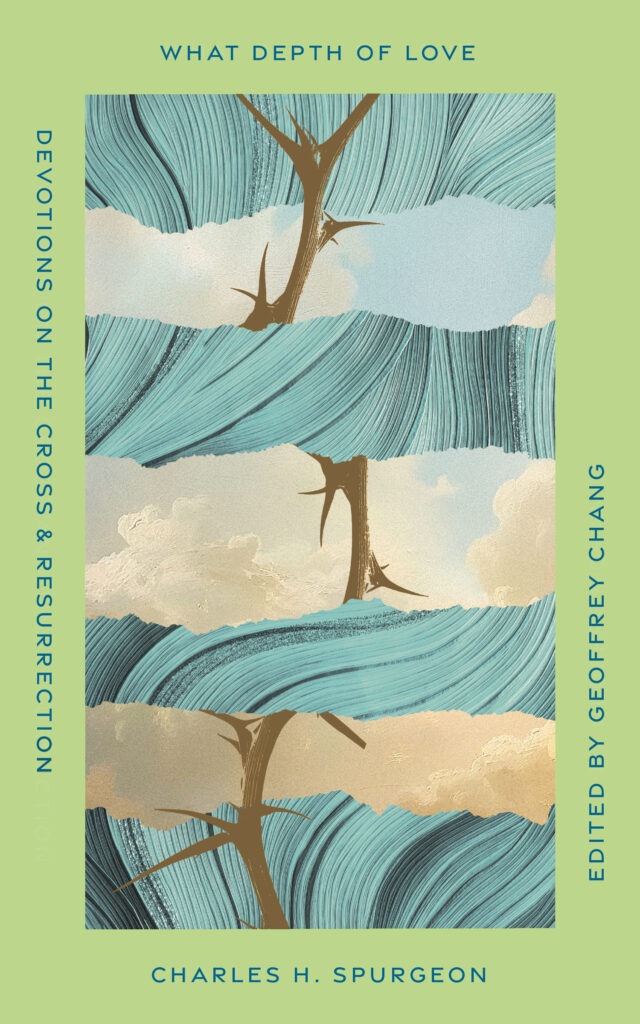
What Depth of Love
This Easter season, meditate deeply on Christ’s final moments before his death and his triumphant resurrection with forty devotions taken from the sermons of Charles H. Spurgeon. Compiled by Geoffrey Chang, curator of the Spurgeon Library at Midwestern Baptist Theological Seminary.