
“I said, ‘O Lord God of heaven, the great and awesome God who
keeps covenant and steadfast love with those who love him and
keep his commandments, let your ear be attentive and
your eyes open, to hear the prayer of your servant that I
now pray before you day and night for the people
of Israel your servants, confessing the sins of the
people of Israel, which we have sinned against you.’”— Nehemiah 1:5–6
When the people of Israel returned to Jerusalem after exile, the city was run-down, and its wall was destroyed. The book of Nehemiah recounts its namesake’s effort to rebuild the wall and restore God’s city for the sake of God’s glory. Nehemiah’s prayerful dependence, devotion to the Word, and commitment to lead in repentant faith offer a timeless template for spiritual leadership.
In this study, we’ll follow Nehemiah’s journey from the Persian royal court to the battered streets of Jerusalem. We’ll bear witness as he, enabled mightily by God, heads the rebuilding effort and the rededication of God’s people to God’s praise. And along the way, we’ll learn valuable lessons on leading well, dealing with opposition, and joining together in fervent commitment to biblical worship and godly living.
Key Themes
- The Lord hears prayer (1:4–6).
- The Lord works providentially, especially through powerful rulers, to bring about His greater purposes (e.g., 2:8).
- The Lord protects His people. Because of this, they need not be afraid (4:14).
- The Lord is merciful and faithful to His promises despite His people’s ongoing sin (9:32–35).
- Worship is at the center of the life of God’s people. It includes the willing, joyful giving of resources (10:32–39).
- God’s people need to be on their guard against their own moral weakness (chapter 13).1
Setting
During the time of Nehemiah, the Persian Empire had reached its greatest extent, engulfing nearly the entire Near East. In 539 BC the Persians under Cyrus the Great defeated the Babylonians and absorbed the lands of Israel and Judah (which they called “Beyond the River”) into their empire. The next year Cyrus allowed the people of Judah (now called Jews) to return home and rebuild the temple of the Lord. Several waves of returning Jews resettled in Judea. In about 445 BC, Nehemiah was granted permission to rebuild Jerusalem’s ruined walls.2
Characters
Nehemiah: the central figure of the book, a Jew who left his post in the Persian royal court to lead Jerusalem in their rebuilding effort
Tobiah the Ammonite and Sanballat the Horonite: two prominent opponents to Israel’s rebuilding efforts
Ezra: a scribe who led a wave of returned exiles from Persia and who led the people in the reading of the Law, prayer, and corporate confession
Eliashib: the high priest during the time of Nehemiah’s leadership who failed to uphold God’s law and maintain proper temple worship
The Book of Moses / Book of the Law: the first five books of the Old Testament
Cupbearer: the person who was responsible for the king’s cup and was thus in an important position of trust, with direct access to the king
Feast of Booths: a Jewish holy day that celebrated God’s provision in the harvest and His saving the people from Egypt (Leviticus 23:33–43)
Covenant: a binding, relational agreement between God and His people
Tithe: a tenth part of produce or earnings set aside by God’s command for the support of the Levites and priests
Nehemiah 1:1–4: Learning from the Past
“As soon as I heard these words
I sat down and wept and mourned for days,
and I continued fasting and praying
before the God of heaven.”— Nehemiah 1:4
Study the Book
An old story goes that in the eighteenth century, a man once went to hear the evangelist George Whitefield preach on a Monday night. The sermon that evening was on John 3:16. On Tuesday night, the man came back; Whitefield preached on John 3:16. Wednesday night, the same thing: John 3:16 was Whitefield’s preaching text. The repetition spurred the attendee to ask, “Mr. Whitefield, are you planning on doing another sermon anytime?” And Whitefield replied, “I will start a new sermon when you start doing what I told you about in the first sermon.”
This lighthearted anecdote conveys a profound spiritual truth: The Christian life is in large part a matter of simple obedience to biblical instruction.
The book of Nehemiah deals in basic principles. It reveals simple truths to which we must adhere if we would ever accomplish anything of lasting worth for God. Despite the fact that we live in very different circumstances from those of Nehemiah, with many voices telling us how we ought to live our lives, we must hold fast to the underpinning truths of God’s Word.
When we open the book of Nehemiah, we’re introduced to plain teaching around which God’s people may organize their lives.
Historical Background to Nehemiah
Before we begin to grasp these teachings, however, we need to understand something of the time and place in which Nehemiah is set. The book’s opening verses provide us with crucial historical and narrative background.
In one sense, the story of Nehemiah begins long before its time, its themes reaching at least as far back as the shepherd boy David. After David was anointed as king (1 Samuel 16:1–13) and assumed the crown following the death of Saul (2 Samuel 2:1–7; 5:1–16), the nation flourished. Despite all his aberrations (the most familiar of which is his sin with Bathsheba, recounted in 2 Samuel 11), David closely followed the Lord in such a way that after his forty-year reign, Israel was financially, militarily, and spiritually powerful. But it was only a short time before his son Solomon led Israel away from God (1 Kings 11:1–8).
Following Solomon’s death, the great nation divided. The twelve tribes of Israel became ten and two, the former (called Israel) settling in the regions to the north, the latter (called Judah) settling in and around Jerusalem to the south.
The Northern Kingdom, without the Jerusalem temple to worship in, resorted to idol worship. God sent His messengers, the prophets, to call His people back to godly living, but they refused again and again. So around 732 BC, God moved the Assyrians to begin invading the Northern Kingdom, resulting in the capture of the capital, Samaria, in 722 BC. With God’s merciful help, Judah held on for several generations in the south. But beginning in 597 BC, the Babylonians began carrying Judahites into exile in Babylon in several waves—a trend that culminated when they destroyed the temple in 586 and carried away all but the poorest of the land (2 Kings 25:8–12). Once again, as before in Egypt, God’s people were enslaved in a foreign land.
In 539 BC, Babylon itself was conquered by the Medo-Persian Empire. It was under the rule of this new power that the events of Nehemiah occurred. In His sovereign providence, God used Cyrus, the Persian king, to release the Israelites from their captivity so that they might return to Jerusalem (Isaiah 45:1, 13; Ezra 1:1–4; 2 Chronicles 36:22–23). (The exchanging of geopolitical power in history is a passing reminder to us that our times are in God’s hands. The rise and fall of nations and their regimes are entirely under His control.)
Ezra 1–6 records the return of the initial waves of exiles from Persia, their efforts to rebuild the temple and reinstate worship, and the opposition they faced from nearby enemies. Though work stopped for a time, the Jews eventually completed the new temple with Persian approval. More than fifty years later, though, when news came to Nehemiah about the state of the city (Nehemiah 1:3), the city wall remained, shamefully, broken.
Narrative Background to Nehemiah (1:1–4)
We can acquaint ourselves with the book’s beginning by asking and answering four simple questions:
- Who is involved? “Nehemiah the son of Hacaliah” (v. 1). We know nothing about Nehemiah apart from his name and what he will go on to accomplish in this book. It is not his pedigree and credentials that will matter so much as his place in the purposes of God.
- When is it? “The month of Chislev, in the twentieth year” (v. 1). Chislev is the Old Testament equivalent to our November–December, in the twentieth year of the Persian king Artaxerxes I’s reign—i.e., around 445 BC.
- Where is it? “In Susa the citadel” (v. 1). Susa was the capital city of Persia. Nehemiah lived in a prominent place!
- What was he doing? Nehemiah “was cupbearer to the king” (v. 11). This was an important position of trust within the court, as Nehemiah would have been charged with managing and safeguarding what the king would drink. He would have regular access to the king in this role.
Verses 2–3 record the report Nehemiah received concerning Judah. The circumstances were dire, described with the words “trouble,” “shame,” “broken down,” and “destroyed” (v. 3). Nehemiah had perhaps been hoping to hear a good report concerning Jerusalem. Instead he heard of the rebuilding project’s failure.
In verse 4, we can learn a great deal from Nehemiah’s reaction (an immediate response) to the news, as well as his action (his first purposeful step in doing something about the problem).
First, Nehemiah reacted. “As soon as I heard these words,” Nehemiah recounts, “I sat down and wept and mourned for days, and I continued fasting and praying before the God of heaven.” We teach our children that we’re responsible for our reactions, because how we react to circumstances reveals a great deal about us. Nehemiah’s response to the news of Jerusalem shows the depth of his devotion and the extent of his compassion. Our love for someone will spur us on to share in their pain. And so with Nehemiah: Caring deeply for his brothers and sisters in Jerusalem, he felt deeply regarding their setback.
Nehemiah’s reaction should lead us to ponder: When was the last time we wept out of spiritual concern for God’s glory in the world? Do we find ourselves broken because of the predicaments facing the church of God? Many faithful ministers of God have stood in pulpits and pled with their congregations through tears. Do we show the same care for Christ and His Gospel?
Yet notice that while Nehemiah’s reaction was tears, his action was fasting and prayer. In fasting, he set aside the normal intake of food for the express purpose of seeking God. In prayer, he cried out to the God of heaven to act on his behalf. Interestingly, the time between 1:1 and chapter 2, when Nehemiah departs for Jerusalem, spans three or four months. Nehemiah clearly devoted himself to significant prayer before ever springing into action!
Nehemiah prayed because prayer is one of the means through which God works. In prayer, we’re not overcoming some reluctance in God. Biblical prayer is in fact a laying hold of God’s willingness. Nehemiah knew that the restoration of Jerusalem could not happen unless God did it. If the city and its people would rise again, it would only be on account of God’s direct intervention.
As Cyril J. Barber writes, in our own lives, the reasons we don’t pray may be reduced to three: We’re self-sufficient, talking only to ourselves; we’re self-satisfied, acknowledging no need in ourselves; or we’re self-righteous, having no basis upon which to approach God at all.3 The key issue for most of us isn’t when or how we’re praying; it’s whether we’re praying in the first place.
In two or three sentences, summarize the main point of this passage. How does it fit into the broader picture of God’s revelation?olly, he wound up vexed and sorrowful. This, too, he discerned, is a striving after the wind.
Live Out the Book
The book of Nehemiah teaches us the basic principles of what it means to do God’s work God’s way. The question with which we will be faced in our study is immensely personal: Are we prepared to enlist ourselves in God’s spiritual army for kingdom usefulness? Do we believe that God, as He did with Nehemiah, has placed us where we are for this time? In truth, there is a work for God that only we can do, because God has prepared it beforehand for us in Christ (Ephesians 2:10).
God is sovereign over history. How does this truth affect how you live and pray?
Like Nehemiah, Jesus felt deep emotions and took action when His circumstances called for it. Where in the Gospels do we see Jesus expressing sorrow and relying on prayer? How can His example inspire our own action?
What was a piece of bad news that you received recently? What was your reaction (immediate response)? Did you engage in action (a first purposeful step)? How would it look to imitate Nehemiah’s (and Jesus’) example in your own life?
1 Taken from the ESV® Study Bible (The Holy Bible, English Standard Version®), Copyright © 2008 by Crossway, a publishing ministry of Good News Publishers. Used by permission. All rights reserved.
2 ESV® Study Bible, 2008.
3 Cyril J. Barber, Nehemiah and the Dynamics of Effective Leadership (Neptune, NJ: Loizeaux Brothers, 1991), 19–20.
Excerpted from Nehemiah: Doing God’s Work, God’s Way © 2026 by Alistair Begg. Used with permission of New Growth Press. May not be reproduced without prior written permission.
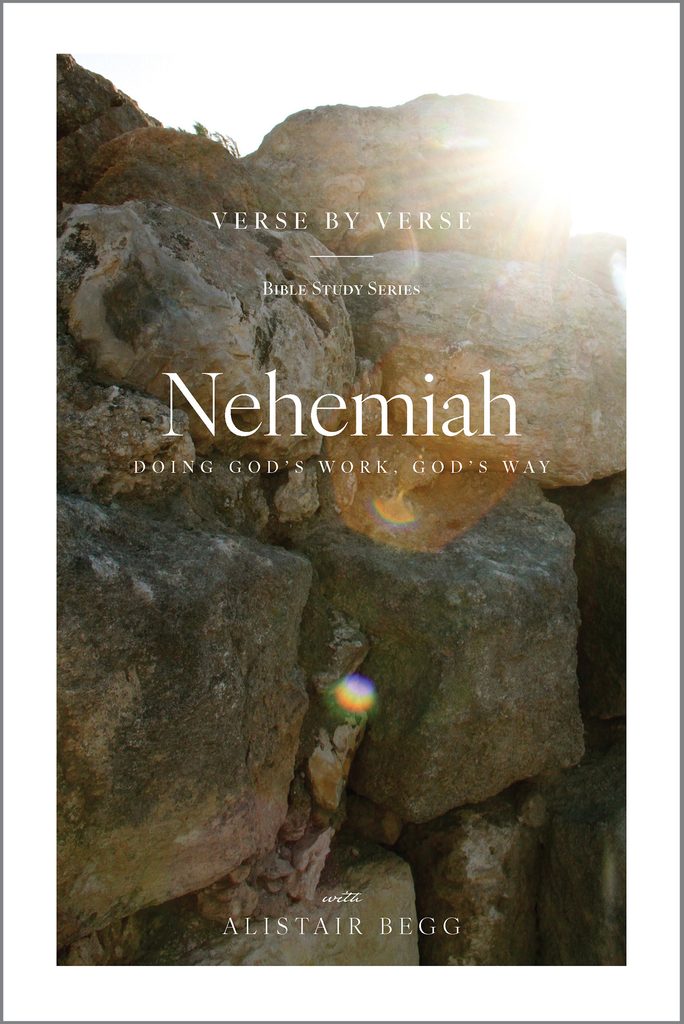
Nehemiah: Doing God’s Work, God’s Way
When the people of Israel returned to Jerusalem after exile, the city was run down and its wall was destroyed. The book of Nehemiah recounts its namesake’s effort to rebuild the wall and restore God’s city for the sake of God’s glory. In this twelve-week, verse-by-verse study, you’ll follow Nehemiah’s journey from the Persian royal court to the battered streets of Jerusalem. You’ll bear witness as he, enabled mightily by God, heads the rebuilding effort and the rededication of God’s people to God’s praise.