
“All Scripture is breathed out by God and profitable
for teaching, for reproof, for correction,
and for training in righteousness,
that the man of God may be complete,
equipped for every good work.”— 2 Timothy 3:16–17
In an early-church era filled with temptations toward compromise and confusion, Timothy—a young pastor and the apostle Paul’s protégé—and his fellow believers faced mounting pressure to loosen their grip on the Gospel. But Paul, writing from a Roman jail and nearing death, urged him to stand firm—to guard the truth, endure suffering, and pass on the message of Jesus and the salvation He secured for those who believe in Him.
In this study, we’ll journey through Paul’s final letter and discover what it means to live with Gospel resolve in a culture that resists it. When so many abandon sound teaching for spiritual speculation, we can remain faithful. But first, we must embrace the sufficiency of Scripture, God’s promise of preservation, and the power of grace. The Christian life isn’t a sprint; it is, as Eugene Peterson once described it, “a long obedience in the same direction.”1 And by God’s strength, we can finish well.
Key Themes
- suffering
- perseverance/preservation of the saints
- endurance through tribulations
- the sufficiency of Scripture
- dealing with false teaching
Setting
Paul likely wrote 2 Timothy between AD 64 and 67, during a second imprisonment in Rome following a fourth missionary journey that is not recorded in the book of Acts. Expecting that death would come soon, Paul wrote this “farewell” letter to Timothy, who was at Ephesus, urging him to stand firm and asking him to come for one final visit.2
Characters
Paul: apostle, missionary, and author of several New Testament books, including the Pastoral Epistles (1 and 2 Timothy and Titus)
Timothy: the recipient of the letter, Paul’s child in the faith, and a pastor at Ephesus
Words/Phrases/Definitions
A Trustworthy Saying: a phrase that appears five times in the Pastoral Epistles, used to identify a fundamental Christian teaching
Sound Words / Sound Teaching: the healthy, true doctrine of the Christian faith, rooted in Scripture and passed down through apostles like Paul
In Christ Jesus: a favorite phrase of Paul’s, occurring seven times throughout 2 Timothy, emphasizing the need for salvation through and spiritual union with God’s Son
The Last Days: the time spanning Christ’s first and second advents
2 Timothy 1:1–7: Paul and Timothy
“To Timothy, my beloved child:
Grace, mercy, and peace from God
the Father and Christ Jesus our Lord.”— 2 Timothy 1:2
Study the Book
In what is believed to be his final New Testament letter, Paul wrote to urge the young pastor Timothy toward Gospel faithfulness. At this point, Paul knew his time was running out. Having “fought the good fight” (2 Timothy 4:7), the apostle was concerned that Timothy would also finish well. Much like the crucial moment in a relay when the baton is passed from one runner to the next, Paul and Timothy had reached a pivotal juncture in the relay of faith: Paul had passed on the Gospel message with which he was entrusted, and Timothy was to pass it on to others ahead of him (2:2).
Our task today is not all that different from Timothy’s. Christians everywhere face the challenge of receiving, guarding, and handing off the good news of Jesus for the next generation. Whether single or married, parents or grandparents, new believers or established Christians, we are to be links in the chain of Gospel inheritance.
In his commentary on 2 Timothy, John Stott states the urgency of the matter:
All around us we see Christians and churches relaxing their grasp of the gospel, fumbling it, in danger of letting it drop from their hands altogether. A new generation of young Timothys is needed, who will guard the sacred deposit of the gospel, who are determined to proclaim it and are prepared to suffer for it, and who will pass it on pure and uncorrupted to the generation which in due course will rise up to follow them.3
The opening verses of 2 Timothy introduce us to the letter’s author, Paul, and its recipient, his protégé, Timothy.
The Letter’s Author: Paul (1:1–4)
Keeping with the standard format of the time, the apostle Paul identifies himself in the letter’s introduction: “an apostle of Christ Jesus by the will of God according to the promise of the life that is in Christ Jesus” (v. 1). To be an “apostle” was to belong to a unique, unrepeatable group around the time of Jesus. Contrary to other views, which may style present-day religious leaders with the term, in the biblical view, the apostles were a once-for-all-time foundation upon which the church was built (Ephesians 2:20). These twelve men accompanied Jesus during His earthly ministry, hand-selected by Christ Himself and commissioned to proclaim the good news (Mark 3:13–15; Luke 6:12–14).
It was to this group that Paul was added. In Acts 9, we read of how Jesus appeared to Paul on the Damascus Road, appointing the former persecutor as the last and the least of the apostles (1 Corinthians 15:8–9). He was then sent out (in Greek, apostellō, the verb we translate as “send”) as an apostle to the gentiles (Acts 26:16–18) to declare what he had discovered—namely, “the promise of the life that is in Christ Jesus” (v. 1). From a dingy dungeon in Rome and while facing the prospect of death, Paul wrote concerning that promise.
Although 2 Timothy has wider readership in mind, Paul’s tone throughout is predominantly personal, as verse 2 indicates. Paul identifies the letter’s recipient as “Timothy, my beloved child.” We have no details of Timothy’s conversion, but it’s likely that he came to trust Christ when Paul visited Lystra, the young pastor’s birthplace (Acts 14:8–23). Paul’s fatherly affection for Timothy surfaces again in verses 3–4, where he tells Timothy that he prays for him consistently and misses him dreadfully. And at the letter’s close, Paul expresses again how he wishes to see Timothy (4:9, 21).
Paul sustains his personal tone in the second half of verse 2, where he identifies three resources available to Timothy for his ministry: “grace, mercy, and peace.” Paul writes here of what he knows experientially. First, grace: As one who previously relied on his religious background for righteousness (Philippians 3:4–9), Paul had come to embrace justification by God’s grace as a gift (Romans 3:24). Second, mercy: Like all of us, Paul was aware of the dissonance between what he was and what he should be; only in pleading Christ’s mercy did he find assurance (Romans 1:15–25). And finally, peace: Having endured much suffering for the sake of the Gospel, Paul knew that when facing inevitable opposition (2 Timothy 3:1–9), his protégé would need Christ, who “himself is our peace” (Ephesians 2:14).
The Letter’s Recipient: Timothy (1:5–7)
Timothy himself comes into greater focus in verses 5–7. Pondering his relationship to Timothy, Paul remembers first the young man’s “sincere faith” (v. 5). Timothy’s belief, in other words, went to the core of his being. In characteristic fashion, Paul describes Timothy’s faith with a verb: It “dwells” in him, as it did in his grandmother and mother. This is part of what it means to be a Christian. By faith, we dwell in Christ, and Christ dwells in us (Romans 8:9). Fittingly, C. S. Lewis likened the Spirit’s work in a person’s life to a spiritual renovation, turning what was once a humble cottage into a glorious mansion, fit for the King to dwell in.4
It’s crucial that we understand the essence of such sincere faith. It is not an act of personal moral or spiritual accomplishment (Ephesians 2:8–9). As William Temple put it, “The only thing of my very own which I can contribute to my own redemption is the sin from which I need to be redeemed.”5 Faith is an empty hand extended to receive the Father’s grace. Further, sincere faith is not mere intellectual assent. Those who believe give credence to God’s promises and exhibit commitment to the Promise Maker.6 The difference between affirming Christian truths and committing oneself to them is like the difference between describing a good meal and actually eating it. The faith Timothy possessed, and that which Paul commends, was experiential.
“For this reason”—that is, on the basis of Timothy’s sincere faith—Paul reminds him in verse 6 “to fan into flame the gift of God, which is in you through the laying on of my hands.” Paul describes the scene in 1 Timothy 4:14: Timothy’s ordination, “when the council of elders laid their hands on you.” The “gift” to which Paul refers is likely the spiritual resources Timothy has for ministry. He, like every Christian, was to steward those resources well.
Paul concludes his opening remarks with the encouragement of verse 7: “God gave us a spirit not of fear”—a timely word for Timothy, who would go on to face external threats and internal pressures at Ephesus—“but of power and love and self-control.” Timothy would require all three of these spiritual resources if he wished to endure in ministry after Paul’s departure (2 Timothy 4:6–8). He would need to lay hold of divine power for strength, according to God’s glorious might (Colossians 1:11). As a pastor, he would have need for the love that “bears all things, believes all things, hopes all things, endures all things” (1 Corinthians 13:7). And, of course, he would need the self-control necessary to order his private life in a way that bolstered his public credibility.
What a word of encouragement this opening paragraph must have been to both Timothy and his congregation! And what a timely word these lines are for Christians everywhere—especially those who share in Paul’s desire to see the Gospel entrusted, preserved, and passed on to those who will come next!
Live Out the Book
“Sincere faith” involves an awareness of Christ’s work for sinners. On the cross, Jesus absorbs the wrath of God meted out against sin. He declares God’s love by being the very sacrifice God requires. (That’s the doctrine known as propitiation.) God is alienated from us because of our sin, and we are alienated from Him. We need somebody to come in between and fix this predicament—not to raise our self-esteem but to secure our eternal destiny. Do you have this kind of sincere faith?
- According to Paul, how had he and Timothy known the grace of the Lord Jesus in their lives to this point? What similar grace can you see in your own life?
- Paul reminds Timothy that God does not give His people a spirit of fear. What do you tend to fear? What would it look like for you to live in light of this promise?
- Why is it important that we pass the Gospel on to the next generation? What steps can you take to ensure you’re doing that?
1 Friedrich Nietzsche, Beyond Good and Evil: Prelude to a Philosophy of the Future, trans. Helen Zimmern (New York: Macmillan, 1907), 107, quoted in Eugene H. Peterson, A Long Obedience in the Same Direction: Discipleship in an Instant Society (Downers Grove, IL: InterVarsity, 1980), 13.
2 Taken from the ESV® Study Bible (The Holy Bible, English Standard Version®), Copyright © 2008 by Crossway, a publishing ministry of Good News Publishers. Used by permission. All rights reserved.
3 John R. W. Stott, The Message of 2 Timothy: Guard the Gospel, The Bible Speaks Today (Downers Grove, IL: IVP Academic, 1973), 22.
4 C. S. Lewis, Mere Christianity (1952), bk. 4, chap. 9.
5 William Temple, Nature, Man and God (New York: Macmillan, 1934), 401.
6 J. I. Packer, Evangelism and the Sovereignty of God (London: Inter-Varsity, 1961), 70–71.
Excerpted from 2 Timothy: Guarding the Truth © 2025 by Alistair Begg. Used with permission of New Growth Press. May not be reproduced without prior written permission.
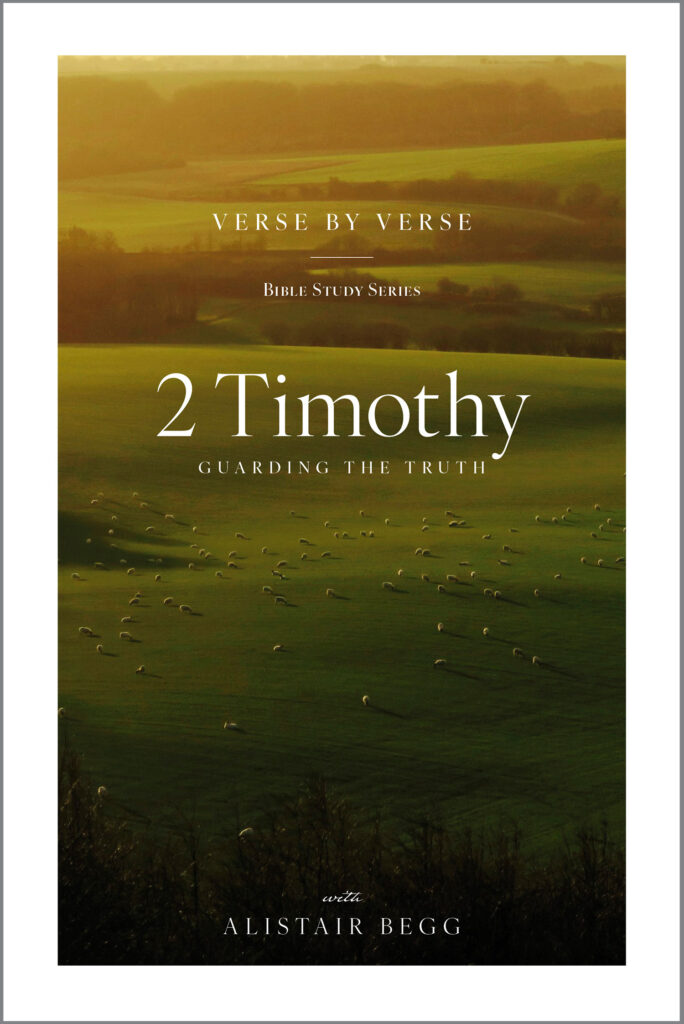
2 timothy: guarding the Truth
In an early-church era filled with temptations toward compromise and confusion, Timothy and his fellow believers faced mounting pressure to loosen their grip on the gospel. But the apostle Paul, writing from a Roman jail and nearing death, urged his young protégé to stand firm—to guard the truth, endure suffering, and pass on the message of Jesus.