
This Easter season, readers are invited to meditate deeply on Christ’s final moments before his death and his triumphant resurrection through the teachings of Charles H. Spurgeon. In What Depth of Love: Devotions on the Cross and Resurrection, Geoffrey Chang, curator of the Spurgeon Library at Midwestern Baptist Theological Seminary, has compiled forty devotions taken from Spurgeon’s sermons to help readers grow in their love for Christ and be renewed by the glorious truths of the gospel.
Spurgeon’s deep understanding of scripture, made accessible to modern readers, will enrich the reader’s walk with Christ, help them cherish the glorious hope of salvation, and encourage them to proclaim him boldly. From Gethsemane to Golgotha to the empty grave, these sermons proclaim Christ crucified and risen, the blazing center of Spurgeon’s theology and ministry.
In this interview with Geoffrey Chang, we get to know more about Spurgeon and this new devotional for the Easter season.
Q: Introduce us to What Depth of Love, the new 40-day devotional from the sermons of Charles Spurgeon.
If you know anything about Charles Spurgeon’s sermons, you know that he loved to preach about the person and work of Christ. No matter where he was preaching in the Bible, he always looked for a “road to Christ.” The saving work of Christ in the gospel was the heart of the Bible’s message. Therefore, it’s no surprise that throughout his 63 volumes of sermons, Spurgeon repeatedly went preached sermons on the suffering, death, and resurrection of Christ. Drawing from the four Gospels, these sermons gave Spurgeon an opportunity to meditate deeply on the work of Christ. This devotional, draws from these sermons, walking through the passion narrative to the resurrection and helping the reader to dwell on what Christ has done for them.
Q: What was Spurgeon’s goal for every sermon that he preached?
Spurgeon’s goal in every sermon was to bring his hearers to Jesus. He didn’t simply want to bring them to an idea or a theory or a concept. He wanted them to encounter the living and reigning Christ, their Savior, in all His multi-faceted glory.
Q: How was Spurgeon able to accomplish his other goal of presenting the gospel as “ever fresh and ever new”?
Spurgeon, like the Puritans before him, had the ability to meditate on the Bible deeply. As one who lived in the Bible text, he had an ability to synthesize the theology of the Bible and show all the rich interconnectedness of it. And then, taking any passage, he had an ability to meditate on the rich truths of that passage and apply it to his hearers’ lives. In presenting the gospel “ever fresh and ever new,” Spurgeon was not inventing a new gospel or coming up with alternative theories of the gospel. He was firmly rooted in historic Christian orthodoxy. But Spurgeon had the ability of bringing out new insights, perspectives, applications, and reflections on the truths of the gospel in a way that continues to be helpful down to our day.
Q: Spurgeon preached during a time when a “new theology” was on the rise. What was this new theology of the time, and how does it compare to some of the false teachings and worldviews of today?
This new theology would come to be known as theological liberalism. This was a theology rooted in human reason rather than in the authority of Scripture. Those who embraced this new theology in Spurgeon’s day continued to affirm the language of the historic doctrines of the Christian faith, but were reinterpreting those doctrines for a modern, anti-supernatural age.
So, for example, the atonement, rather than being Christ’s substitutionary death for our sins, was now primarily an expression of God’s love or an example to follow. The resurrection, rather than being bodily, was now reinterpreted as spiritual and moral. Theological liberalism continues to be influential in our day as Christians continue to be tempted by reinterpretations of historic Christian teaching to fit modern thought. But in these sermons, we see Spurgeon taking a stand against such innovations and holding fast to historic Christian teaching, and in that, he is an example for us today.
Q: These devotionals allow the reader to slow down to meditate and focus on some of the fascinating aspects of Christ’s final moments on earth. What are some of the finer details and questions that Spurgeon explored in his teachings about Jesus’s death?
There are many! On Day 10, Spurgeon meditates on Christ’s silence before Herod, and he writes, “Do you not think that this peculiar silence of Jesus was a part of his anguish, in which he was bearing punishment for your sins of the tongue? Ah me, ah me! Redeemed of the Lord, how often have you misused your speech by wanton words!”
Day 33 meditates on how Christ offered his wounds to Thomas to address his fears. Spurgeon cautions us for looking for comfort in ourselves, our prayers, our performance, our circumstances. Instead, he writes, “When you want comfort, crave no sign, but turn to the wounds of your Lord. You see what Thomas did. He wanted faith, and he looked for it to Jesus wounded… These are founts of never-failing consolation, from which, if a man once drinks, he shall forget his misery, and remember his sorrow no more.”
Q: To give an example of this closer examination of the details, there are various aspects of the last supper that we normally focus on, but we don’t talk much about Jesus singing after the meal. Why don’t we talk more about the significance of the Passover hymns that were sung and the worship that took place in the upper room?
The hymn after the last supper is a detail that we can so easily miss, and yet Matthew clearly includes it in his gospel. Part of the challenge is that we can be so familiar with the story that we don’t stop to reflect on these wonderful little details.
In preaching on this verse, Spurgeon suggests, “This singing of the Savior also teaches us the whole-heartedness of the Master in the work he was about to do… he advances to the conflict like a man who has his full strength about him.” It is a reminder to us that Christ did not go to the cross cowering or unwillingly, but he went as one who was ready to lay his life down for his sheep. He was ready to do his Father’s will.
Q: How do Spurgeon’s teachings on the cross and resurrection address the doubts and struggles of modern believers?
Modern believers (and unbelievers) are wrestling with the same fundamental problem that all of humanity has struggled with since the beginning of time: How can I be saved? How can my sins be forgiven? How I know peace with God? In answer to those questions, Spurgeon doesn’t point us to ourselves. He doesn’t point us to abstract statements about the love of God. No, he points us to a bloody cross and an empty tomb.
There, at the cross, Jesus objectively bore the sins of his people and satisfied the wrath of God, suffering and dying in their place. And in his resurrection, Jesus rose to newness of life, overcoming death and promising eternal life to all those who would trust in Him by faith. For a restless world, here is solid ground where we can rest. Here is an objective, accomplished salvation that we can receive through repentance and faith in Christ.
Q: Do you have a favorite devotional from What Depth of Love? If so, which one it is and why?
This is a hard question, but my favorite devotional is, perhaps, Day 20, “The Saddest Cry from the Cross.” Here, Spurgeon, meditates on and wrestles with the cry of dereliction. What could it mean for the Son of God to cry out, “My God, my God, why have you forsaken me?” How could it be that the Son would ever be forsaken by His Father?
Spurgeon writes, “I cannot comprehend, so I shall not pretend to be able to explain them. There is no plummet that can fathom this deep; there is no eagle’s eye that can penetrate the mystery that surrounds this strange question. I feel more like one who has looked into a deep mine—or like one who has been part of the way down, and shuddered as he passed through the murky darkness btu who would not dare to go much lower… this cry… is a tremendous deep; no man will ever be able to fathom it.”
In our day, where many teachers and songs speak of the cross in a casual and familiar way, I am grateful for Spurgeon’s sober theological reflection at the mystery of the atonement. How is it that Christ could bear our forsakenness? Spurgeon does offer an answer. But before he does so, it is worth reflecting on what a marvelous mystery it is that the Son would ever be forsaken by the Father. What Depth of Love is a fitting title because Christ’s sacrificial love is truly a bottomless deep!

Q: With there being forty days of devotionals, What Depth of Love fits perfectly with reading for Lent, but what do you think Spurgeon would say about using this book in preparation for Easter?
He would say this is a great way to use this season to grow in your heart’s affection for Christ and confidence in his finished work. However, he would also say, “Don’t limit yourself to meditating on the work of Christ only to the Easter season. Every season is the right season for considering all that we have in Christ!”
Q: What Depth of Love is part of the Old Made New series. What other devotionals are already available in the series, and what is yet to come?
We have two others available, A Wondrous Mystery: Daily Advent Devotions and Your Only Comfort: Devotions for Hope in Suffering. We have one more devotional coming in August 2026, Breath of the Soul: Devotions for Powerful Prayer. Once all four are available, they will form a nice devotional library with two meditating on the person and work of Christ (incarnation, cross, and resurrection) and two meditating on the Christian life (suffering & prayer).
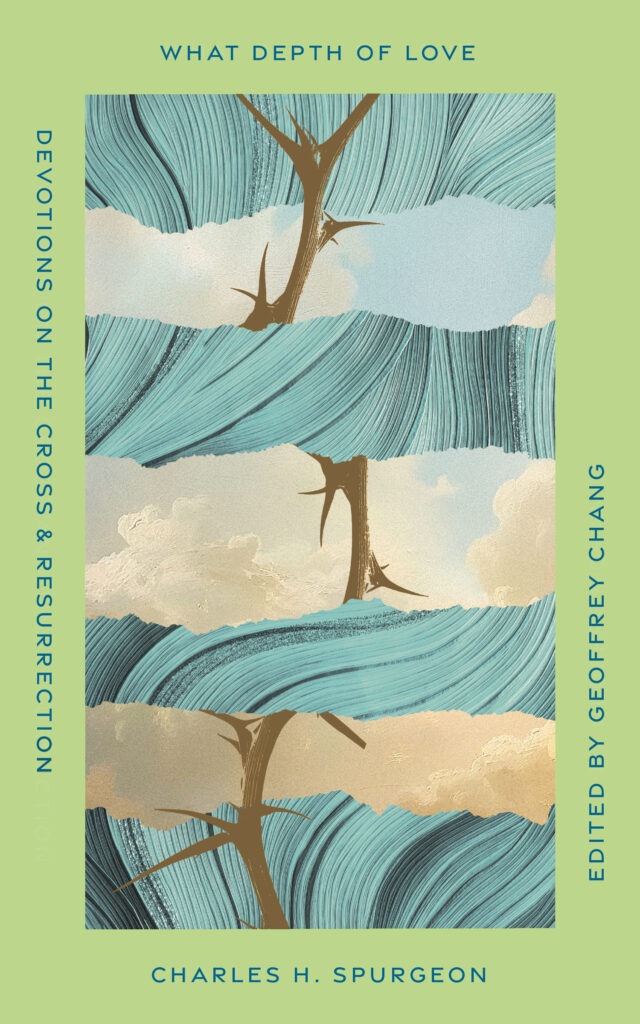
What Depth of Love
This Easter season, meditate deeply on Christ’s final moments before his death and his triumphant resurrection with forty devotions taken from the sermons of Charles H. Spurgeon. Compiled by Geoffrey Chang, curator of the Spurgeon Library at Midwestern Baptist Theological Seminary.