
Women are under so much pressure from every angle that sometimes we need to be reminded of the foundation of grace that is under us. The book of Romans holds a beautiful message and convincing argument of God’s grace to us through his Son.
In You Stand in Grace: Devotions for Walking in Faith, conference speaker Abi Byrd invites women to walk with her through Romans and experience firsthand how the gospel transforms lives by revealing God’s great mercy. Each of the eight weeks of this devotional Bible study focuses on a theme of faith such as dependence, cultivating faithfulness, growing in God’s love, and pursuing unity. Byrd helps readers understand how to flourish in the reality of God’s grace, live a life transformed by faith, and foster deeper connection within our Christian community.
In this interview with Abi Byrd, we talk to her about her study of Romans.
Q: Why do you think so many people avoid studying Romans?
Romans can be an intimidating book for many people. It’s a book that is rich in doctrine and heavy on theology. It presents themes like justification, sanctification, and the law—all of which can feel overwhelming if we don’t know where to begin! The way Paul writes can be hard to grasp because he has these exceptionally long run-on sentences. It’s very easy to get lost in them!
Scholars who are much brighter than me can’t agree on some of what Paul was trying to communicate, and their views have sparked debates for centuries! I didn’t want to approach Romans for that reason. I wasn’t sure I was going to be able to understand it correctly, and the last thing I wanted to do was to be heretical! I don’t think I’m alone in this. Romans can often remain on people’s “To Be Studied” list, as there are many other books which seem more attainable on our own.
Q: How is You Stand in Grace different from other devotionals and Bible studies available on the book of Romans?
I really wanted this book to feel accessible to anyone who opened it. From the moment you read the introduction to the very last word, I wanted the reader to feel that we were on a journey together. I am typically teaching women to teach the Bible or teaching Bible studies expositionally, so that was the approach I used here. It was hard at first, but I loved the challenge. You can see that each week dives into a different topic based on the focus chapters for the week. You kick off with one or two “Identify” questions to get you thinking. Then there’s the devotional itself which is rooted in the passage for the day, followed by some questions to dig deeper and consider direct life application.
The other Bible studies on Romans that I consulted were either deeper Bible studies that took a lot longer, or they were more commentary style. I couldn’t find anything that set out what I was hoping to do.
Q: How did you approach making the deep theology of Romans accessible in a devotional format?
Honestly, it wasn’t easy. I had my adult kids who are in their twenties read it for me and give feedback. I had a lot of eyes on the manuscript over the months I was writing. I would take the main idea in the text and then break it down as simply as I possibly could. I typically use a lot of words, so I made sure I had people helping me simplify. One of my problems is I think I’m explaining clearly, but in fact, it’s a little muddled!!
Once I got my sea legs under me, I really enjoyed the challenge of making the material as accessible as possible. I think I accomplished the goal, as one of my Arabic friends sent me a note saying it was easy enough for her to understand and work through. English isn’t her first language, so that was extremely encouraging. One thing that was striking to me was by trying to make this study approachable, I could see life application in ways I hadn’t before. That was stretching and challenging for me. I pray it will be for the people who use the devotional too.
Q: What does it mean to stand in grace?
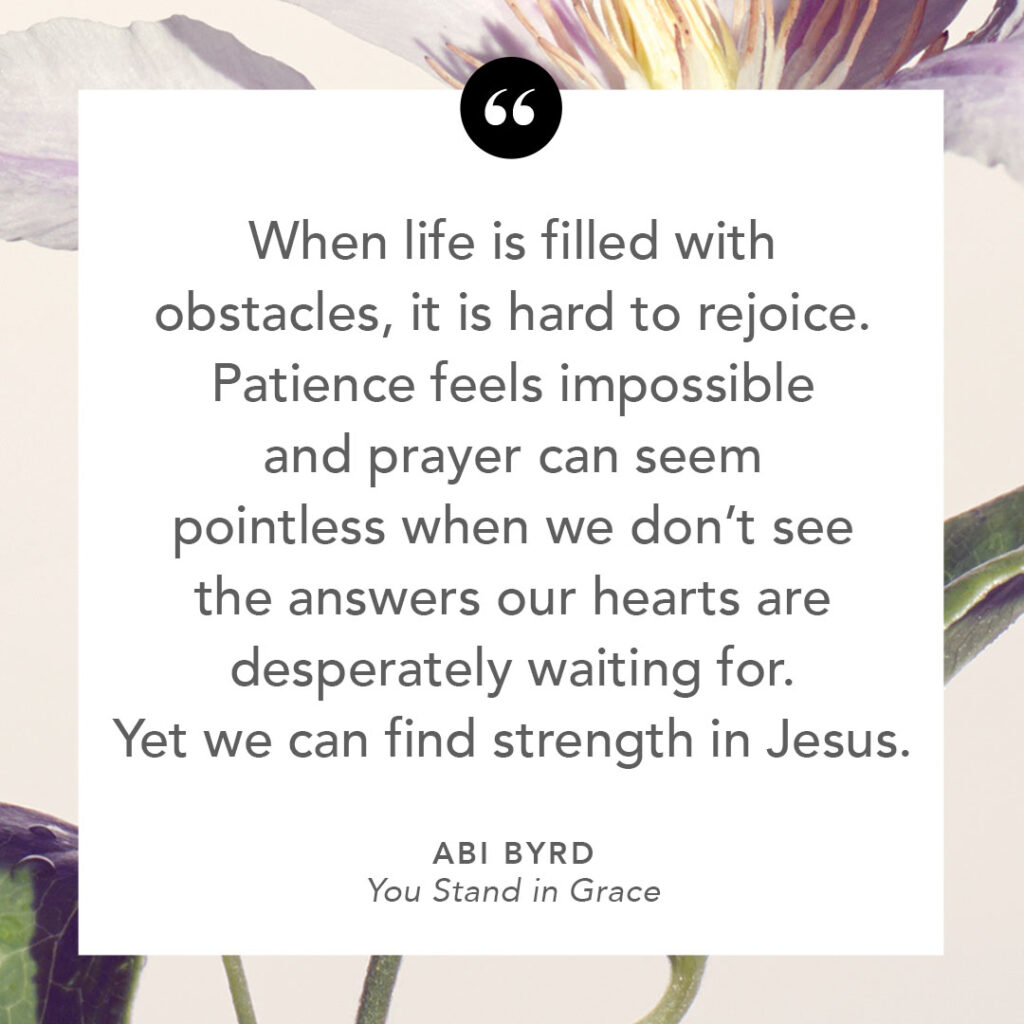
When we understand that Jesus came to rescue us from our sin—and that it was completely undeserved—we begin to understand the concept of grace. Salvation and a reconciled relationship with God are only possible through Jesus’s death on the cross. When we stand in grace, we meditate on that knowledge and understanding. Where I live, people are busy and rushing all the time. We don’t tend to build in time to be in God’s presence and to meditate on things. We want to cross things off our to-do list.
One part of standing in grace is being in God’s presence and meditating on these incredible doctrines surrounding grace that we see in Romans. But another part of standing in grace is learning to live out those doctrines in our lives, striving to be faithful and to apply them so others can see Christ living in us.
Q: How can the truths of Romans help women navigate struggles such as insecurity, fear, and broken relationships?
Romans 4 looks back to Abraham and his example. He was old and his wife was barren, but God promised him offspring, and Abraham believed in that promise. Verse 18 says, “In hope he believed against hope.” Verse 19 goes on to say, “He did not weaken in faith when he considered his own body which was as good as dead.” Abraham trusted in God even when everything pointed to hopelessness, given his human condition. I think his character and the way God showed his faithfulness in the most surprising of circumstances can be such an encouragement when we are walking through really hard struggles, when we are fearful, and when we have broken relationships. Verse 20 says, “No distrust made him waver concerning the promise of God, but he grew strong in his faith as he gave glory to God.”
Something happens when we walk through hard things and are truly seeking to be faithful believers. Our faith grows stronger, and we can give God the glory, even in the most dire situations. I can attest to the numerous times this has proven true in my own life. The gospel gives us hope when life feels hopeless. We see this throughout God’s Word, but particularly in Romans. Being reminded of the testimony of people in God’s Word and how they trusted God shows us that we can trust him in the same way too. God remains faithful and we can see that throughout salvation history.
Q: How does Romans, right from its opening verses, challenge our perspectives on busyness and priorities?
Romans opens in chapter 1 by reminding believers that they are called to belong to Christ. As a result, we are part of a global family, something only made possible by Jesus’s death on the cross and his resurrection. Our focus shifts from ourselves to Jesus, our Rescuer. It’s a reminder to take the time to stop and dwell in the presence of the One who called us to himself. Focusing on Jesus and his work on the cross reorders our priorities and challenges the way we live. It makes us consider what we are filling our day with. In today’s culture, busyness has become a god. I need to be reminded that God is the one who can order my day, not my to-do list.
Q: In what ways does Romans encourage Christians not just as individuals, but as a community of believers? Why is the community aspect so important?
Romans reminds us that we are part of a global family when we become believers. We are united around the gospel, even though we struggle with different circumstances, are tempted by different things, and might even have different opinions on certain issues. Romans shines a spotlight on the fact that as Christians we are united around what Jesus has done for us. We are called to love one another and outdo one another in showing honor. We are to encourage one another and build each other up, pointing each other to Christ. We do this as a community and a family, not as individuals. The way we love each other not only spurs us on and shows care for one another, but it is a witness to those looking in. We reflect Christ as we do family life together as a community of believers.
Q: There’s a lot of talk these days about freedom—freedom of religion, speech, choice, etc. What is true freedom in Christ and what does it allow us to do?
We can misunderstand freedom until we look at it from a biblical perspective. We are free in Christ because he paid the debt for our sin. What we were once slaves to; we are now completely free from. It doesn’t mean we aren’t tempted to sin, but it means we have been completely forgiven and we have power in Christ to say no to sin.
Jesus’s death on the cross was a gift we didn’t deserve. Romans 5:20 says, “Where sin increased, grace abounded all the more, so that, as sin reigned in death, grace also might reign through righteousness leading to eternal life through Jesus Christ our Lord.”
This incredible grace frees us from our previous life. We now have a new life because of Christ’s resurrection. It’s an incredible thought, and as we comprehend it more clearly, it gives us great freedom as we move from being dead in our sins to life in Christ.
Q: You offer a powerful comparison between the life of an Olympian and the life of a Christian. What are some of those similarities?
An Olympic athlete only gets to the Olympics due to their skill, discipline, and setting their minds on the prize. Becoming an Olympian is a lifestyle. How we live as Christians reveals who we are in Christ. Our lifestyle completely changes when we are believers, because the motivations and circumstances of our lives are entirely different than they were before we were saved. Romans 8:9 says, “You, however, are not in the flesh but in the Spirit, if in fact the Spirit of God dwells in you.” Verse 10 goes on to say, “But if Christ is in you, although the body is dead because of sin, the Spirit is life because of righteousness.”
The Holy Spirit living in us helps us live in the way God intended. But it requires discipline on our part;it means we raise our eyes to Jesus and who he is. We can completely depend on the Holy Spirit and trust he continues to do a redeeming work in our lives as we spend time in God’s Word and long for heaven.
The big difference for Christians in comparison to an Olympian is that our medal is a certainty. When an Olympic athlete arrives at the games, there is no guarantee for them that they will walk away with a medal. For Christians, our hope is certain. Our prize is guaranteed.
Q: Tell us about the challenges that are included at the end of each week of devotions. Would you give us an example of one or two of them?
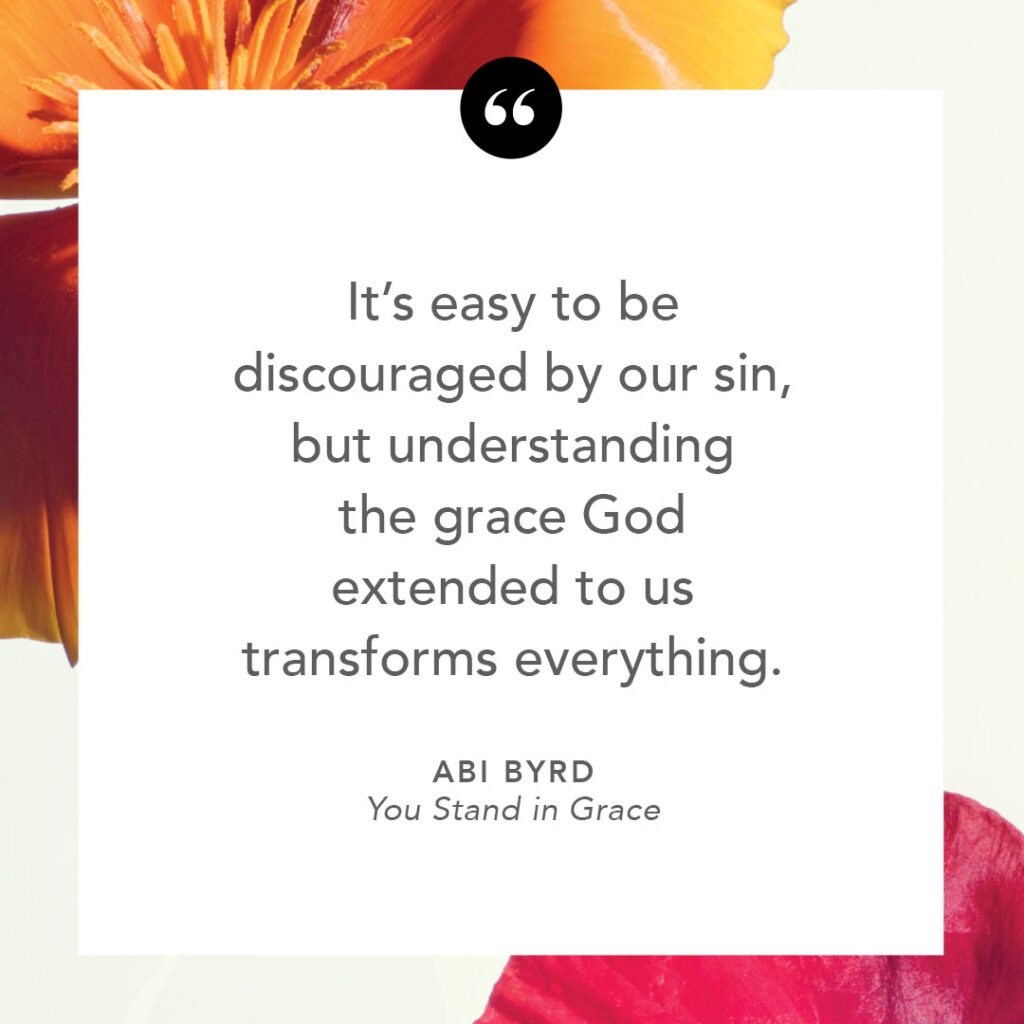
At the end of each week, there is a challenge to take and share with others. At the end of the week titled Faithfulness (week 5), the Take and Share challenge talks about how God never promises that life will be easy. In fact, as we read God’s Word, we see the opposite. But as we walk through suffering, we can persevere, endure, and cling to God–we aren’t alone in our suffering. The challenge is to be bold and remind other believers that we aren’t alone, that we can draw near to Christ in our difficulties, because he understands. For those who are unbelievers, the challenge is to bring to help them see that they don’t need to suffer alone. There is One who has already suffered and who knows what they are walking through. He is a loving, faithful God.
Another challenge is from the week on love. We can decide that we are far too ordinary to be used by God, that others are far more worthy and capable. But Romans 12 reminds us that our lives are a living sacrifice and when people look at us, they should be able to see Jesus. This Take and Share challenge encourages us to love our neighbors in extraordinary ways and to share the light of Christ with someone who doesn’t know him. It’s a reminder that God uses ordinary people to do extraordinary things!
Q: How have you been changed as a result of writing You Stand in Grace?
To be honest, I never really saw myself as a writer. I have had the privilege to teach and speak for several decades now, but writing was something I always shied away from. Taking the time to write this devotional made me slow down and think about every word I was writing. It made me think from a different angle about how this book of Romans transforms our lives. It reminded me of so many truths I couldn’t wait to share with others through the pages of the book. It showed me God’s faithfulness in the lives of people not only in the Bible but in my own life too as I wrote about the ways we have seen God be faithful, care for us, and show us his grace and mercy.
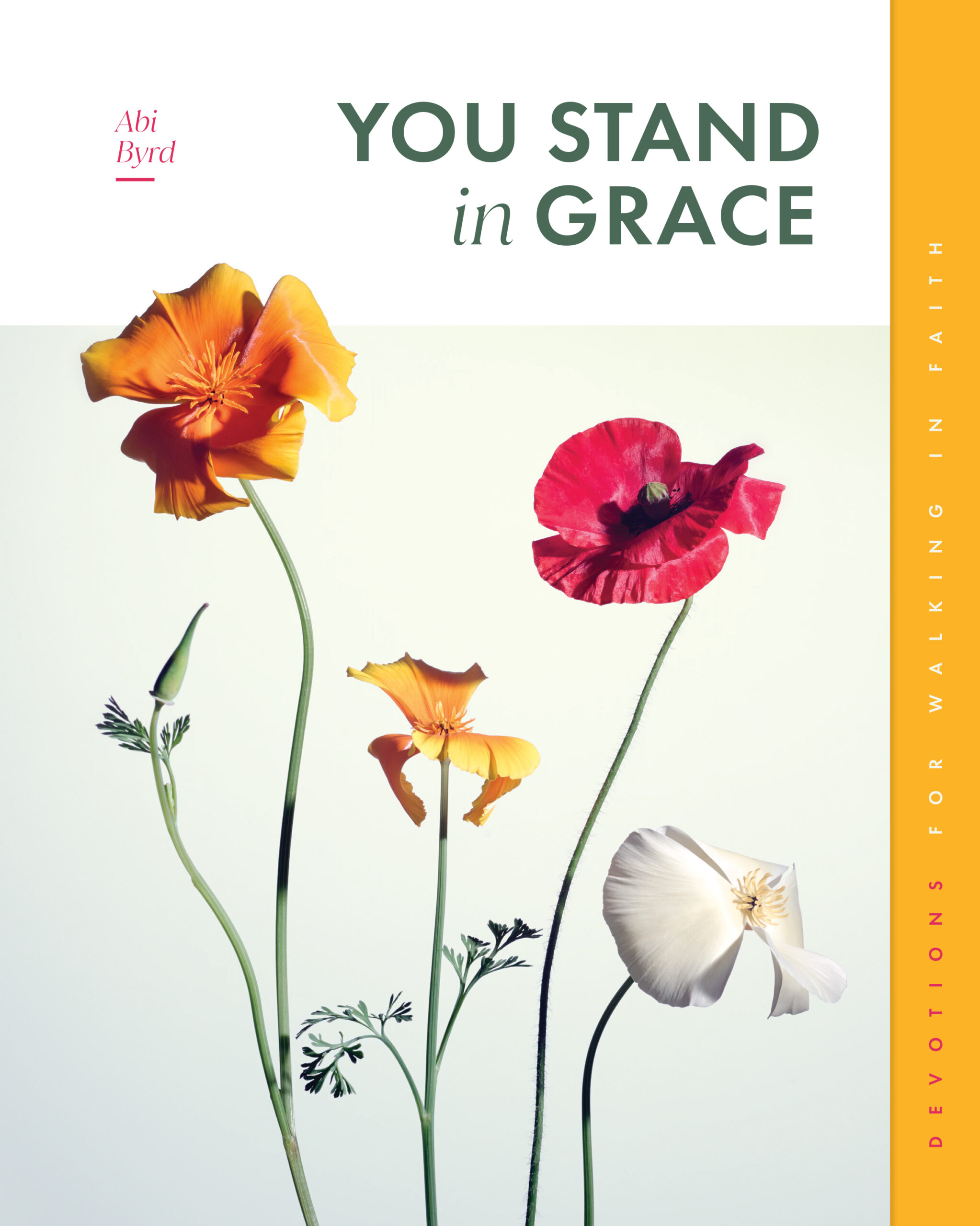
You Stand in Grace
In You Stand in Grace, conference speaker Abi Byrd invites women to walk with her through Romans and experience firsthand how the gospel transforms our lives by revealing God’s great mercy. Each of the eight weeks of this devotional Bible study focuses on a theme of faith such as dependence, cultivating faithfulness, growing in God’s love, and pursuing unity. Byrd helps readers understand how to flourish in the reality of God’s grace, live a life transformed by faith, and foster deeper connection within our Christian community.