
I don’t think it would be an exaggeration to say that as a church living in the modern world, we don’t really know what to do with a book like Lamentations. Traditionally, the book has been read in the Christian church during Holy Week. But unless you keep the church calendar, I doubt you have read the book of Lamentations on an annual basis every Easter season. If you read through the Bible each year, then you will have read it at some point in the year, but I wonder if you’ve known how to read it properly, how to understand it, how to set it within the Bible’s grand storyline, and even what to do in response to reading it.
Perhaps we don’t know what to do with it because our surrounding culture is a culture addicted to hedonism, to pleasure seeking. Technology and social media also mean we don’t meditate on anything for more than a few seconds, never mind the topic of lament. We’ve all seen images of bloodshed and war on the news, but have they caused us to stop and offer up a prayer of lament? A technological age addicted to clicking, swiping, and scrolling doesn’t lend itself to lamenting. Our culture is averse to any serious engagement with sin and death, with suffering and sorrow, and I think this has affected Christians more than we might like to think. We don’t really know what to do with a book like Lamentations, which is full of relentless lament. If we’re honest, lament is a lost discipline in the church at large. (Mark Vroegop’s book Dark Clouds, Deep Mercy is a helpful corrective.)
And yet God wants his people to lament. It’s why he has dedicated a whole book in the Christian Scripture to this one subject—Lamentations—a book of laments. As such, it is a place to begin to learn how to lament.
The early church father Athanasius said, “The Scriptures speaks to us; but the Psalms speak for us.”1 I think that Lamentations does both—it speaks to us about lament, but it also speaks for us when we experience something terrible that causes us to lament.
As we begin this study on the book of Lamentations, let me invite you to learn from this book of laments so that you might know how to lament for the times when you will need to lament.
Let’s consider a couple of things as we begin:
PATHOS (THE FEEL OF LAMENTATIONS)
Lamentations is full of pathos—it’s full of emotion. One of the most moving books in the Bible, it serves as a fitting complement to Job or some of the psalms of lament.
Hear the depressing note expressed for a beloved city in its opening verse: “How lonely sits the city that was full of people!” (1:1). Or the pitiful cry of the lonely figure of chapter 3: “Remember my affliction and my wanderings, the wormwood and the gall!” (3:19). Or the impassioned plea of the exiled community in chapter 5: “Remember, O Lord, what has befallen us; look, and see our disgrace!” (v. 1). The words of this ancient book draw us in and stir our emotions and affections.
But its purpose was not simply to stir our emotions and affections—the purpose of the book is to call God’s exiled people to repentance for their sin and to hope in God’s steadfast love for their forgiveness and restoration.
The author of Lamentations seeks to express in words what that final destruction of city and temple meant for the people of God. Judah and its city and temple were in the state they were in because of their own sin. This was a reality they had to face up to, but when they did—as hard as that reality was—there was hope for them (Lamentations 3:22–24).
Judah had to realize that just as God had the power to punish them for their sin, so he had the power to restore them after they had sinned. This is why the book ends:
Restore us to yourself, O Lord, that we may be restored!
Renew our days as of old—
even though you have utterly rejected us,
and remain exceedingly angry with us.
~ Lamentations 5:21–22 (author’s translation)
So that is the purpose of the book: to call God’s exiled people to repentance for their sin and to hope in God’s steadfast love for their forgiveness and restoration.
The suffering that Jerusalem-Judah experiences at the hand of the Lord is a result of their covenant unfaithfulness (for example, Lamentations 1:5b, 14a, 18a). In this sense, there is no real mystery to the suffering of Jerusalem-Judah compared to the book of Job. In the book of Job, Job is presented as an “innocent” sufferer; in Lamentations, Jerusalem-Judah is presented as a “guilty” sufferer. The suffering makes sense because it is a result of their sin.
And yet, the punishment from God still comes as something of a surprise, given what Jerusalem and her people meant to God (Lamentations 2:15; 4:20; 5:17–18). In the Old Testament, especially in psalms like the Songs of Zion (Psalms 46; 48; 76), Zion is described as impenetrable and inviolable precisely because God was in her midst. This is what was so shocking to Jerusalem-Judah—the God who promised to be in the midst of her, like a shield protecting her from her enemies, became in her midst a fire destroying her.
How could this be? It was because of the covenant arrangement between God and Israel. We need to read Lamentations against the backdrop of Deuteronomy 28, where God had warned and threatened disaster on his people if they disobeyed him. Lamentations records just such a disaster because of their covenant unfaithfulness. What we see in Lamentations is the misery that Jerusalem-Judah experiences as a result of their sin.
CHRIST IN LAMENTATIONS
Lamentations presents us with the bad news of sin and judgment but also the good news of hope and deliverance according to God’s steadfast love. However, connecting the book to Christ can be difficult. There are no predictive prophecies in the book, nothing that explains what the future Messiah will do. To find Christ in Lamentations, you have to look at people, things, and events (what biblical scholars call “types”) that show us what the Messiah will be like—types such as the ruined temple (John 2:19), or the prophet who weeps over the city that has rejected God (Matthew 23:37–38), or the city that is suffering, or the exile itself. Seeing these connections will enrich our understanding of the beauty and glory of Jesus as the great Man of Sorrows, who as the leader of God’s people underwent great suffering for his people’s sins. As we will see, Jesus is the ultimate prophet, priest, and king who suffers; the ultimate temple that is destroyed; the ultimate city that experiences God’s wrath.
- Athanasius, Letter to Marcellinus, paraphrased in John Goldingay, Psalms, vol. 1, Psalms 1–41 (Baker Academic, 2006), 23 (emphasis added).
Excerpted from Lamentations: How Christ Lifts the Burden of Sin and Sorrow © 2025 by Jonathan Gibson. Used with permission of New Growth Press. May not be reproduced without prior written permission.
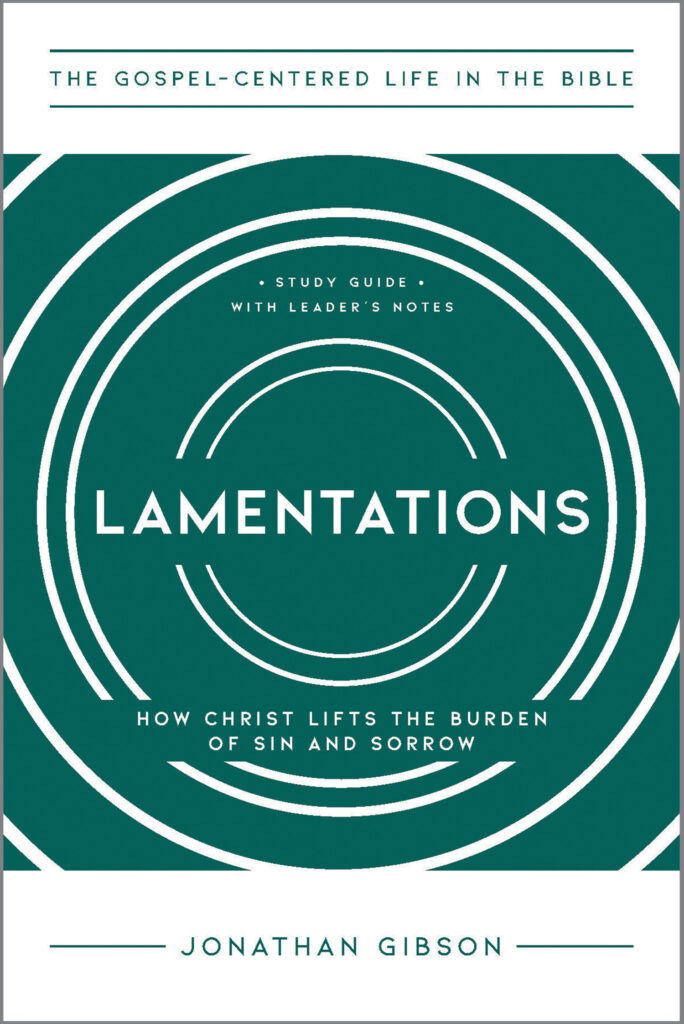
Lamentations: How Christ Lifts the Burden of Sin and Sorrow
What do we do when life goes very wrong? The biblical answer is that we start by turning to God and sharing our distress and pain with him. In his Bible study of Lamentations, Jonathan Gibson helps participants recover the lost, biblical art of lament and points us to Christ, who bears all our burdens.