Every Christian parent deeply desires their children to know and love the Lord. One way we can disciple them in this direction is by teaching our children the attributes of God. The more they know about his character, the more reasons they’ll have to be in awe of who he is and what he has done.
In the last few years, I’ve thought a lot about how to approach this teaching. There are many options: organizing an alphabetized list (A is for Almighty, B is for Beautiful, C is for Compassionate), writing a song, or simply teaching classic hymns like “Immortal, Invisible, God Only Wise.”
These are all great ideas, and surely all will be helpful for kids, but I think we often overlook the most obvious tool—a tool God has already given us. That tool is story.
The Power of Story to Teach
God has revealed himself to us through the story of Scripture—a story that is not only true, but also completely captivating. And story has power: It sticks with us.
We can teach kids that God is holy, and we can explain the definition of holiness—that God is perfect, pure, separate, and distinct. But we can also show them the holiness of God by telling them about the vision of Isaiah in Isaiah 6. Isaiah saw God’s throne room, and above him were six-winged creatures—angels called seraphim. The seraphim used two of their wings to cover their faces, two to cover their feet, and two to fly. As they stood above his throne they cried, “Holy, holy, holy is the Lord Almighty!” (6:3 NIV). At the sound of their voices the foundation of the thresholds shook, and the house was filled with smoke.
Isaiah was in despair. How could he, a sinful, unworthy man, approach the holy God? Even these beautiful angels had to cover their feet and their eyes! “Woe is me! I am ruined!” he cried (6:5).
This powerful image will stick with your kids long after your family devotional time. Now when they think of God’s holiness, this image of Isaiah and his peek into God’s throne room will spring into their minds, and they, like Isaiah, might tremble a bit. But their hearts will also be filled with hope, because they will remember that God made a way for Isaiah to approach him. One of the seraphs touched Isaiah’s lips with a burning coal, cleansing him (vv. 6–7). They will remember that God can make them clean too.
One Story, One God
Using story as our teaching tool for learning God’s attributes has another major benefit. As we go through the Bible—through God’s one big story—we see the same God throughout. We can emphasize to our kids that God does not change. There is not an Old Testament God and a New Testament God. The angels who cried “Holy, holy, holy!” in the book of Isaiah are still crying “Holy, holy, holy!” in Revelation.
And just as God is holy throughout Scripture, he is also powerful and in control. He does not weaken in power or control at any time. Neither does he become more or less compassionate and loving as the story progresses. God never changes his opinion on sin. God never throws off one attribute to display another. He does not remove his justice when displaying his mercy. He is constant and consistent. God is all of his attributes, all the time.
As you read through the Bible with your kids, talk about which attributes of God are on display in each story. In the account of the Exodus, you might emphasize his saving power, his judgment of the Egyptians, his control over nature, his love for his chosen people, or his faithfulness in keeping his promises. The more you do this, the more your kids will be able to pick these things out on their own, and they will grow in their trust and confidence in the Lord, who never changes.
Jesus Displays the Attributes
As you delve into the New Testament with your kids, be sure to point out how Jesus displays all of the Father’s attributes. One of my favorite passages to demonstrate this is Mark 2, where a group of friends bring their paralytic friend to Jesus to be healed. They lower him down through the roof of a house where Jesus is teaching, because it’s too crowded to get him in through the door. Jesus says to the man, “Son, your sins are forgiven” (2:5). The Pharisees think, “Who can forgive sins but God alone?” (2:7)
Jesus knows their thoughts—he’s omniscient because he’s God! And he can forgive sins—because he’s God! And he demonstrates his power to everyone watching by healing the man, who promptly stands up and walks home. God is omniscient, forgiving, and powerful, and so is Jesus.
Communicable and Incommunicable Attributes
A final thing to consider when teaching the attributes of God to kids is the difference between communicable and incommunicable attributes. Communicable attributes are ones we have too, though to a lesser degree. God is love, and he commands us to love him and love our neighbors. God is merciful, and we can reflect him by being merciful too. God has the power to create, and we can be creative, though we can’t create out of nothing. He also calls us to be holy, wise, patient, just, faithful, and truthful as he is.
Incommunicable attributes are attributes we simply do not have. God is omniscient, omnipotent, and omnipresent, and we are not. Nor are we self-existent, self-sufficient, infinite, eternal, sovereign, or immutable. Often we would like to be these things, but we are not.
As you discover God’s communicable attributes throughout his story, talk about how we can reflect him. As you discover his incommunicable attributes, talk about how we are different from God, and why that is indeed very good! We can embrace our limits and rest, knowing he is in control. He’s perfectly taking care of us and the entire world as only he can.
Keeping It Simple
Teaching the attributes of God really doesn’t need to be that complicated. It can be as simple as reading a passage and asking, “What does today’s story reveal to us about God?”
Keeping this question on the forefront of your mind will spark all sorts of wonderful conversations with your kids, and as you reflect together on the character of our incredible God, your heart will be encouraged as well.
Who Is God?
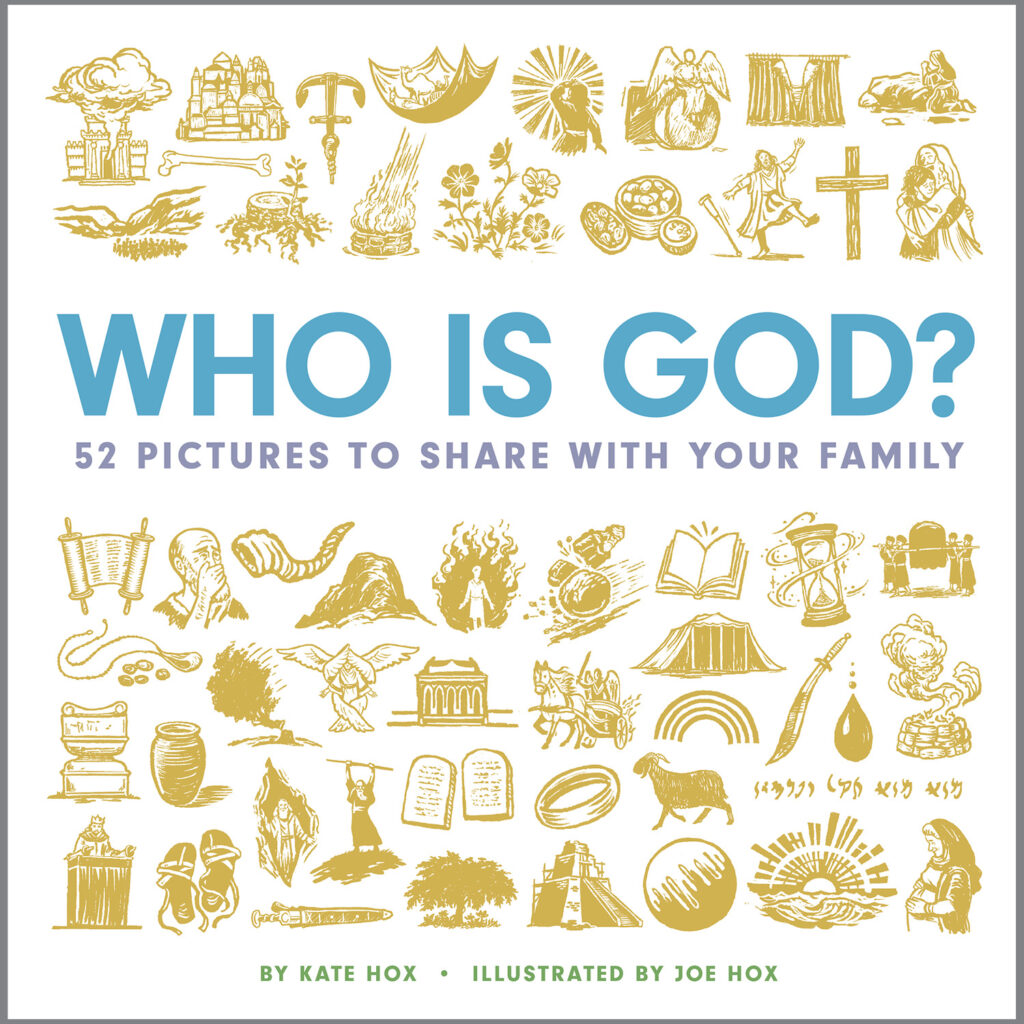
Who Is God? invites families to get to know God better through fifty-two devotions and pictures that display his attributes, characteristics, and names. Devotions written by Kate Hox are paired with illustrations by Joe Hox to present families with a big view of God, who is the same yesterday, today, and forever. Each devotion includes a captivating illustration, a key verse to remember, Bible passages for reference, reflection questions, and song suggestions.