
Americans are notorious for needing vacations from their vacations. We work extra hours to save up an exorbitant amount of money so that we can plan an extended vacation for rest. During this “restful” vacation, we try to see all the sites, snap all the pics for all the posts, and eat at all the highest-rated restaurants. If our step counts outpace our spending, we have succeeded!
You don’t have to go on expensive vacations to exhaust yourself in the search of rest. While Amazon can bring a red-light mask, a foot bath, and a new book promising better time management right to your doorstep, the peace we deeply desire and desperately chase is not able to be packaged. And, even if we succeed in emptying our schedules so that we can cease from work, we struggle to turn off the mental toil that marks the modern age.
The Durable Rest We Desire
Americans have been wrestling with a restless spirit since the founding of our nation. When French diplomat Alexis de Tocqueville studied our burgeoning democracy, he noted a sense of restlessness:
In the United States a man builds a house in which to spend his old age, and he sells it before the roof is on . . . he settles in a place which he soon afterwards leaves to carry his changeable longings elsewhere…At first there is something surprising in this strange unrest of so many happy men, restless in the midst of abundance. The spectacle itself, however, is as old as the world; the novelty is to see a whole people furnish an exemplification of it.
~ Alexis de Tocqueville, Democracy in America (Bantam Books, 2004), 658–659.
I wonder what de Tocqueville would have said if he could have time-traveled to the present day. Modern technology, promising more ease, seems to have only added intensity to our frantic chase after peace and rest. We run faster, try harder, buy more, and travel farther; yet rest seems to elude us still. Our restlessness stems from a deep desire for durable rest. Our desire for such rest isn’t wrong, but the destinations in which we hope to find it often are.
The Rest God Intended
Long before the birth of our nation, at the founding of our fledgling planet, we get a glimpse of the rest God intended for humanity. Adam and Eve were formed to flourish in right relationship with God. Through that anchoring peace with their Maker, they also experienced peace between them, within them, and outside them.
In the beautiful poetry of the first two chapters of Genesis, we see God creating complementary pairs: light and dark, sky and sea, fish and birds, man and woman. In the final of these complementary pairs, God joins together work and rest (Genesis 2:1–3). Rest was the proper compliment to work, even before sin entered the picture, adding toil to our work and sweat to our brows (Genesis 3:17–19).
Peace flows from a right relationship with God and obedience to his commands, which are for our flourishing. As we center our lives on God and live within the cadence of the Creator (six days work; one day rest), we find peace.
But we wouldn’t have it. Our sin shattered our peace and began our restlessness. Since the fall, our relationship to both work and rest have been maimed. Our elusive chasing after peace yields more exhaustion than rest.
The Rest Christ Restored
After rescuing his people from slavery, God reiterated the right cadence of work and rest established at creation by etching Sabbath into the Ten Commandments. God’s people were to have an entire day to rest and remember that he—not they—were at the center of their existence, provision, security, and peace.
Though rest was etched into the commandments God gave Israel, sin was etched into their hearts. They repeatedly refused to obey God. Yet, through the prophet Isaiah, God invited them to find the rest that comes through repentance: “In returning and rest you shall be saved; in quietness and in trust shall be your strength” (Isaiah 30:15).
Spoiler alert: They refused to listen. And we have been following suit ever since. After so many spurned invitations, you would think God would leave alone us in our restlessness. Yet, wonder of wonders, Christ gives offers us an incarnational invitation:
“Come to me, all who labor and are heavy laden, and I will give you rest. Take my yoke upon you, and learn from me, for I am gentle and lowly in heart, and you will find rest for your souls.”
~ Matthew 11:28–29
Jesus offers this invitation because he was raised on a cross to enable it. Through his life, death, and resurrection, Christ offers the rest that comes from a restored relationship to God. The invitations from Isaiah and Matthew still call to restless hearts today, offering us repentance as a pathway to peace.
While rest is more than repentance, it is certainly not less. The world’s formulas for rest begin with self at the center: Treat yourself. Express yourself. Listen to yourself. Placing self at the center caused our restlessness, and thereby it cannot be the cure for it. Ongoing repentance leads to ongoing rest. Christ at the center of our lives is the source of durable peace.
The Rest That Helps Us Remember
God knows that we are a forgetful people, so he offers us regular rhythms for rest and remembering. Through corporate worship with his people on the Lord’s Day, the Lord’s Supper, and the practice of Sabbath, God invites us into the original cadence of creation. In these, we are invited to remember that God is infinite, and we are finite; God is unlimited, though we are terribly limited; God is faithful even when we are fickle. Sunday by Sunday, as we hear the Word of God preached, we remember the finished work of Christ. In a world that tells us that rest is the reward for the completion of our to-do list, we enjoy the reward of Christ’s finished work on the cross.
Unlike the world’s prescriptions for peace and rest, which rely heavily on the physical dimensions of rest, God offers his people a full-orbed, embodied peace that begins with spiritual realignment. Sunday naps are great. Time with friends who fuel us is welcomed. Ceasing from scrolling is always a good idea. Biblical rest includes these in its scope though it doesn’t make them the focus. When the focal point of rest is Christ, all the other forms of rest radiate out from the source.
The Rest that Awaits Us
The peace that flows from right relationship with God bookends the story of Scripture. We saw it in Genesis, and we see it in Revelation. In the apostle John’s recording of the dazzling realities he saw and heard from Christ, we get glimpses of the glorious rest that awaits the people of God (Revelation 21:1–6). A full and forever rest, untainted by sin and unobscured by self, remains for those who repent and return to Christ.
Until we enter that rest, we must carry our restless hearts back to rest in Christ through the pathway of repentance. In a world exhausted from chasing elusive rest, we can display the durable rest our Redeemer purchased for us as the price of his life.
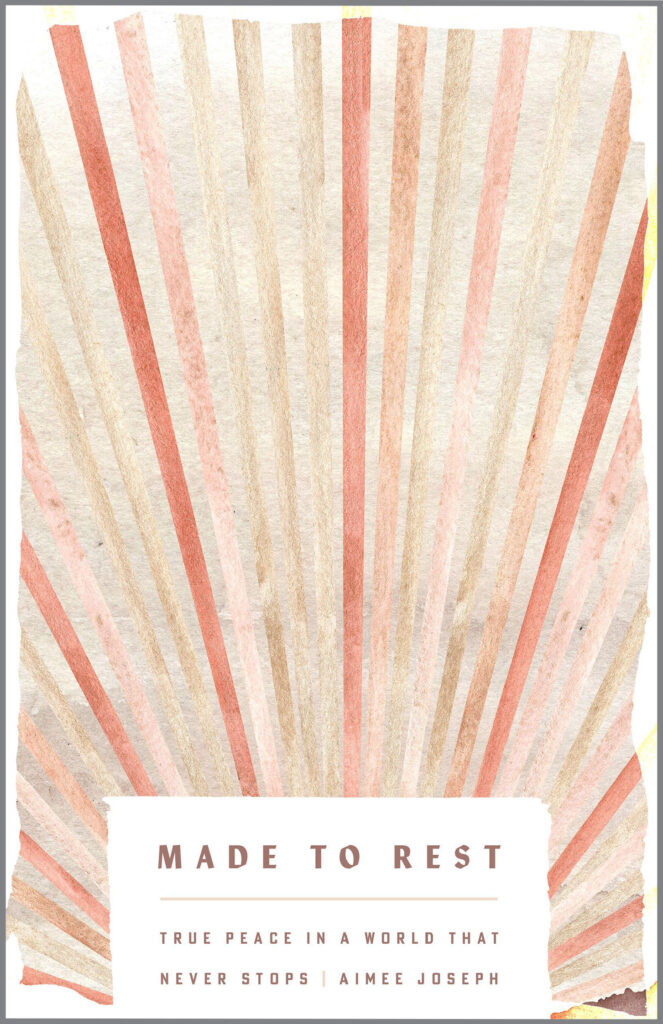
Made to Rest
With the relentless pace of modern life, we have become accustomed to high mobility, near-constant change, and a rampant sense of restlessness. Finding any sense of rest seems impossible. Drawing from Scripture, personal anecdotes, and practical wisdom, Amy Joseph explores the roots of our internal agitation and points to the Source of true rest. She invites readers to move beyond the world’s definition of rest such vacations and self-help strategies to cultivate rhythms of renewal that align with God’s design.