
After decades of working with young people, I assumed I understood their world. I was probably wrong about how much the culture had shifted beneath my feet. In a fast-changing society, an adult’s experience does not always keep pace with the youth, even if you are a parent, a teacher, or someone who works closely with children.
Recently, I asked my Gen Alpha daughter why she thought adults so often struggle to understand young people today. She didn’t hesitate. “The older generation doesn’t understand us because they didn’t grow up like us. It’s as simple as that.”
Her answer stopped me in my tracks. Not because it was rude or dismissive, but because it was such an honest one. It named the growing gap between generational experiences and expectations. We may be breathing the same air, but we are living in very different worlds. No wonder connection can feel harder than it once did.
When faced with a generation that feels unfamiliar, our instinct is rarely curiosity. We are quick to assume decline rather than difference. And this pattern is nothing new.
In 1907, a Cambridge student named Kenneth John Freeman documented how young people had been criticized throughout history. They were accused of contradicting their parents, chattering before company, gobbling up dainties, crossing their legs, and tyrannizing their teachers.[1] Apparently, even then, enthusiastic snacking was a sign of moral collapse.
We see this negative pattern today in how adults often talk about the next generation. They are labeled fragile, distracted, or entitled, often as if they have emerged in isolation rather than being shaped by the world we have created around them. When that happens, young people can begin to look past the help and input of real-world adults and instead turn to online influencers to shape their views, values, and expectations. George Orwell captured this well when he wrote that each generation imagines itself more intelligent than the one before it, and wiser than the one that comes after it.[2]
You might expect Christians, of all people, to push back against this instinct with grace. Yet if we are honest, we too can be quick to judge, slow to listen, and tempted to see the next generation as a problem to fix rather than a people to love.
When I told a Christian friend I was writing a book about Generation Alpha, they replied, half-joking and half-serious, “So you’re writing about how we’re all doomed, then?” That comment stuck with me, because beneath the humor sat something deeper.
Many adults feel frustrated when young people fail to meet expectations that are often unspoken. Beneath that frustration sits anxiety about the world their kids are growing up in, uncertainty about whether they will cope, and a quiet grief for what might be lost.
But that approach is neither hopeful nor helpful. Judging the next generation is easy. Understanding them takes more work.
So perhaps there is a better lens we, as Christians, can choose: curiosity. If we are serious about becoming more like Jesus in our response to the next generation, the desire to understand must come before the urge to criticize. Putting ourselves in someone else’s shoes remains one of the simplest ways to bridge the generational gap.
And as my daughter reminded me, the world of Generation Alpha is unlike any that has come before it. Generation Alpha, those born from around 2010 onward, are growing up in a world few of us recognize from our own childhoods.
Many in Generation Alpha are anxious-minded. They are more aware of mental health than previous generations, yet often carry levels of worry that feel too heavy for their age, with around one in four experiencing significant anxiety or emotional distress.[3] At the same time, there is a strong instinct to influence the world for good, with many caring deeply about fairness, justice, and making a positive difference. Their formative years were pandemic-impacted, with disruption reshaping confidence, learning, and security for many families. Childhood is now rarely offline and is shaped by screens, notifications, and constant comparison. And an AI-shaped future brings both opportunity and new questions about identity, trust, and a world many adults struggle to imagine.
Sit with that context for long enough, and a question begins to form. What if we are asking children to carry adult-sized pressures while still in a childlike state, using childlike tools? And if so, who is helping them navigate this new terrain? Are we quietly expecting them to manage it alone?
Cultivating Connection
A posture of connection across generations matters more than we often realize, for two reasons.
First, it is deeply biblical. Scripture calls one generation to tell the story of God to the next, as Psalm 78 reminds us. But that story is rarely heard when listening has not come first.
Second, loving our neighbor often begins by drawing near. Showing up and paying attention matters. Distance makes misunderstanding easy. Closeness allows trust to grow. And when it comes to Generation Alpha, there is more hope than we often expect.
Faith is not off the table for them. Many are open and curious, even if church feels unfamiliar or awkward. What connects is not another religious performance, but faith that is lived and visible.
They may not know our church language, just as many of us do not understand their Gen Alpha slang and memes, but they are asking deep questions about meaning, purpose, justice, and hope. And unlike previous generations, many are not deconstructing faith, because they never constructed it in the first place. They are not walking away from Christianity so much as encountering it for the first time.
That makes this a moment of real possibility, if we are willing to meet them where they are.
Generation Alpha needs you. And you need them. Not as experts with answers, but as people who stay close. That is how Jesus worked. He did not keep his distance. He drew near, walked with people, listened, and stayed. Faith grows through presence, not judgment or withdrawal.
Jesus is the answer for Generation Alpha.
For the anxious-minded, Jesus is peace in a world that feels overwhelming. For leading influencers, he is the Servant King, showing how power is used for others. For the hyperconnected, he offers a deeper connection rooted in relationship rather than algorithms. And for those shaped by disruption, uncertainty, and AI, Jesus is wisdom, stability, and hope for the future.
Jesus is exactly the good news Generation Alpha needs. And in quiet, ordinary ways, you can be good news too. Because the story of Jesus is almost always carried through people who stay close.
Gen Alpha is different. And if we misread their world, we risk missing them altogether. The real question is whether we are willing to understand their world well enough to love them in it and lead them wisely through it.
[1] Kenneth J. Freeman, Schools of Hellas: An Essay on the Practice and Theory of Ancient Greek Education from 600 to 300 B.C. (Deighton, Bell & Co., 1907).
[2] George Orwell, quoted in The Collected Essays, Journalism and Letters of George Orwell, ed. Sonia Orwell and Ian Angus (Secker & Warburg, 1968).
[3] NHS Digital, Mental Health of Children and Young People in England 2023 (Leeds: NHS Digital, 2023).
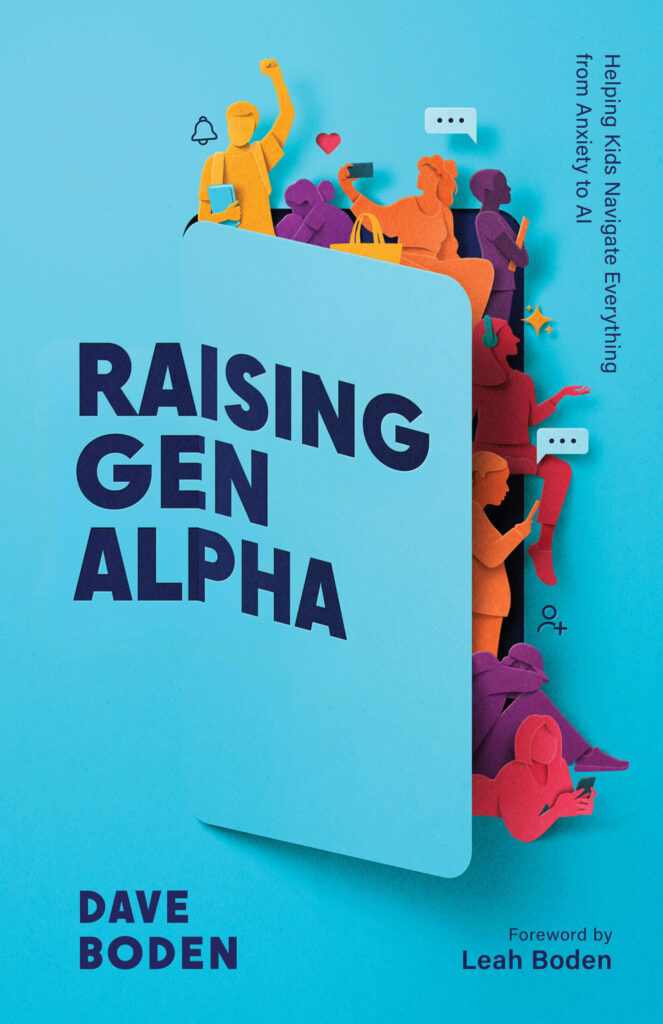
Raising Gen Alpha
Using the acronym ALPHA (Anxious-minded, Leading influencers, Pandemic-impacted, Hyperconnected, and AI-shaped) to explain the challenges and experiences that have shaped them, author Dave Boden equips readers to disciple Gen Alpha with clarity, compassion, and confidence. By understanding the world today’s children are growing up in, we’re better prepared to equip them with the faith and insight they need to thrive.