
In a relational crisis, determining realistic expectations and identifying wise nonnegotiables is difficult. It can feel like trying to corral a bag of spilled marbles on a ship during a tropical storm. With every new piece of information, with every conversation that goes poorly or well, with each memory you’re trying to recontextualize, it feels like the marbles (i.e., expectations) move all over the place.
It’s normal to feel this way given what you’re facing. “Normal” doesn’t mean easy. Knowing that something is common doesn’t always bring comfort. But it does help you realize that your response isn’t because of something you’re doing wrong, as if most people in your situation corral their marbles easily.
Your first step is to identify realistic expectations for you and your spouse. We also want to help you narrow down what the most important nonnegotiables should be, from within the seeming thousands of realistic expectations you might have.
REALISTIC EXPECTATIONS
What am I allowed to expect? Is it too much to ask her to change cell phones? Is it unrealistic to expect him to never masturbate again? Can I expect him to fully invest in his recovery while at the same time pursue me? Is it selfish to want to be pursued like that at a time like this? The questions can go on and on.
At this stage in the process, it is enough to recognize that you and your spouse are not on the same timetable. Your spouse has known about the sexual sin much longer than you have. What is “breaking news” to you is history for them. These factors greatly impact expectations.
In the next steps, you will begin the process of learning the history your spouse has been living and will learn more about how these separate timetables affect you and your marriage. Having realistic expectations begins with recognizing that the two of you are not on the same page. You are just now realizing why you have been on separate pages.
1. Realistic expectations for you.
You can expect yourself to be all over the place. Angry at the sin. Hurt by the betrayal. Sometimes eager to forgive so you can move on. Sad for your loss. Overwhelmed to the point of being nauseous. Ready to divorce. Yearning for when things were good. Fearful that your whole marriage has been a lie. Questioning your judgment about everything, because if you missed this, what else did you miss? Wondering if your racing thoughts will ever stop. Depressed because you don’t think things will ever be the same. Insecure and wanting to be held. Disgusted at the thought of being touched or intimate again. Then you get angry again as you prepare for another ride on the emotional merry-go-round.
If we tried to take the emotional chaos of the previous paragraph and articulate six common experiences that are reasonable expectations of yourself in the coming days and weeks, those would be the following:
- Your emotions will fluctuate, but a recurrence of unpleasant emotions is not a “setback.”
- As you learn new information about your spouse’s sexual sin, the progress you made previously will be disrupted.
- The common themes of sexuality or betrayal in television, movies, and books will be upsetting.
- “Petty” conflicts of others will be hard to tolerate, find interesting, or feel compassion toward—for a time.
- Sleep and eating habits will be a truer reflection of your progress than your emotions.
- You may excessively cling to those things or people that you view as dependable or that you have control over.
This list is not exhaustive. It is meant to be representative of common responses.
2. Realistic expectations for your spouse.
Change is not a straight line. That hurts to say. There are few instances where this statement hurts more than when we’re discussing betrayal within a marriage. But this does not mean that recurrence of sin is acceptable just because it’s normal. In a moment, we will discuss what to set as nonnegotiables. But before we get there, we will discuss unrealistic expectations during the messiness of change.
“If you love me” or “if you were really sorry” phrases are common ways for unrealistic expectations to get expressed. Consider the examples below. How would you articulate what is unrealistic about them?
- “If you loved me, you wouldn’t struggle with lust. I would just be enough for you.”
- “If you loved me, you would never think fondly of your adultery partner again.”
- “If you loved me, you would be the husband/wife you promised to be.”
- “If you loved me, you would be improving on [blank] responsibilities while pursuing purity and integrity.”
The content of these expectations is not unrealistic. Purity, fidelity, and integrity are reasonable expectations. What often makes these kinds of statements unrealistic is their pace. They lack a sense of process. They are destinations without a journey. They are like a diet commercial with a “Then” (obese; unfaithful) and “Now” (fit; faithful) picture that lacks an exercise or meal plan in between.
3. Realistic expectations for your sexual relationship.
This too is likely to fluctuate. You may be disgusted by sex and not want your spouse to touch you, kiss you, or even be in the room when you change clothes. You may become hypersexual, trying to use sex to recreate the lost security and oneness. You may vacillate between these two responses.
The biggest disruption either reaction brings to the marriage is the way it is viewed later. The hypersexual response is often looked back upon with shame—“My spouse cheats or looks at porn and I shamelessly throw myself at them like I was lucky to be part of their harem.” The desire for security through marital sex is viewed as weakness. Or the hypersexual response can be looked back on as successful—“When I did everything my spouse wanted sexually, they didn’t stray, so I should keep doing it.” But this grounds security in our performance, which is exhausting and leads to imbalanced relationships.
The disgusted-by-sex response is often looked back upon as a source of security—“Avoiding sex kept me safe. I couldn’t be hurt again—at least not in the same way.” But this grounds security in isolation and self-protection rather than trust, which can lead to creating distance in all relationships.
At this early stage, realize that sex will not be normal for a while. Give yourself and your spouse grace when sex is awkward, absent, or intensely emotional. Try to avoid generalizing the current experience of sex as the future normal for your marriage. Nothing is normal right now. Sex is the celebration of intimacy. There is work to be done before intimacy is restored. Until that time, sex will not be what it was designed to be. Allow your expectations of sex to recognize that.
A period of abstinence may be wise, especially when your spouse’s engagement with sexual sin has reached an addicted level where they believe that sex is ultimate. Sex is good and important, but it’s not ultimate. When your spouse views sex as ultimate, more sex or better sex will not be a blessing to your marriage or contribute to their purity. Instead, it may be advisable to agree to a time of sexual fasting. Ninety days is a common time frame for this.
The goal of this kind of sexual fasting is not punitive. The intent is not to withhold sex. Rather, the goal is to establish a proportional role for sex in your spouse’s emotions and your marriage. Sex should not be an antidote to a mutant craving in your spouse. Sex should be a mutual celebration of a mutually valued relationship. Taking a time when you and your spouse demonstrate your commitment to the marriage during a season of abstinence allows sex to be reengaged with a sense that sex is a way to celebrate a good marriage rather than preventing one spouse from being bad.
ESTABLISH NONNEGOTIABLES
What should I ask for? is a common question. But a better one is, What should I not compromise on? At this point, we’re assuming you just recently learned of your spouse’s sexual sin, at least a recurrence of it. In this phase, it can feel like whether “things get better” depends on you knowing what to ask for in the minutes and hours after learning of your spouse’s sin.
What you do or do not ask of your spouse at this time will not be the determining factor in whether they change. There are many choices your spouse and you will make between now and that outcome (whatever it may be). The burden that your immediate choices determine the future of your marriage is not yours to carry.
Your ultimate request is that your spouse takes the necessary steps to forsake their sin and restore the marriage. But that is not what is referred to here as nonnegotiables. Nonnegotiables, as the word is used here, means the immediate steps that are necessary to limit further damage and display the initial fruits of repentance. Until these nonnegotiables are met, the process of restoration has not begun because the actions of destruction continue. Your spouse cannot claim to be rebuilding something they are still actively tearing down.
Here are three nonnegotiables that we encourage you to establish:
1. If your spouse’s sexual sin involves any direct interaction with a real person, they should break off all contact.
This applies to emotional affairs and physical adultery.
Your spouse needs to know that, for your marriage to get better, the adulterous relationship must be cut off. Indecision in this matter is a decision against your marriage. Until your spouse has made a real commitment to end communication with the other person, the uncertainty of your marriage should be reflected in the home (from Help! My Spouse Committed Adultery by Winston Smith).
2. If there was any sexual contact with another person, your spouse should get tested for sexually transmitted diseases.
This nonnegotiable serves two purposes. First, it is a protective measure for your physical health. Until this is done, it is unwise for there to be sexual intimacy between you and your spouse. You should know any health risk you are exposing yourself to when being intimate with your spouse. You will not have the information necessary to assess that risk unless or until your spouse is tested for STDs.
Second, this nonnegotiable requires your spouse to face the physical risk their sin introduced for them and you. It is easy, especially in the early stages of their sin being known, to only focus on the emotional and relational betrayal of their sin. Their sin was immensely hurtful. But it was also dangerous. Getting tested for STDs is not punitive but intended to be sobering toward the impact of their sin; it is part of genuine repentance.
3. If your spouse’s sexual sin involved online activity, accountability software should be installed on each of your spouse’s devices with internet access.
There are many options for this type of software. Some are free; others come with a monthly subscription fee. The primary function of these forms of software is to provide a report of any questionable websites visited on that device. Accountability software also sends a report if the program is turned off while the device is active.
This software is merely a tool that removes counterproductive privacy and provides tangible evidence of change (or lack thereof). But these modest benefits are still significant benefits. In the early stages of pursuing purity and, thereby, restoring trust, they are significant enough that it is recommended to be on your list of nonnegotiables.
CONCLUSION
It is common to feel both exhausted because you’ve done so much and discouraged because you wish more progress had already been made. If that is where you are, it is not a sign that you have done something wrong; it is an indication that you are in the early stages of a hard journey.
As you move forward, you will learn more about your spouse’s sin that will be hard to hear, and you will identify ways their sin has impacted you that you wish weren’t true. Those are heavy steps. The weight of that journey is why it’s important to take time to create a thorough self-care. This journey is not a race, even though you will feel sped up many times. Be sure to take this journey at a sustainable pace and allow yourself to rest or take a break when you need to.
Excerpt adapted from True Betrayal: 9 Steps for Processing Your Spouse’s Infidelity © 2025 by Brad Hambrick. Used with permission of New Growth Press. May not be reproduced without prior written permission.
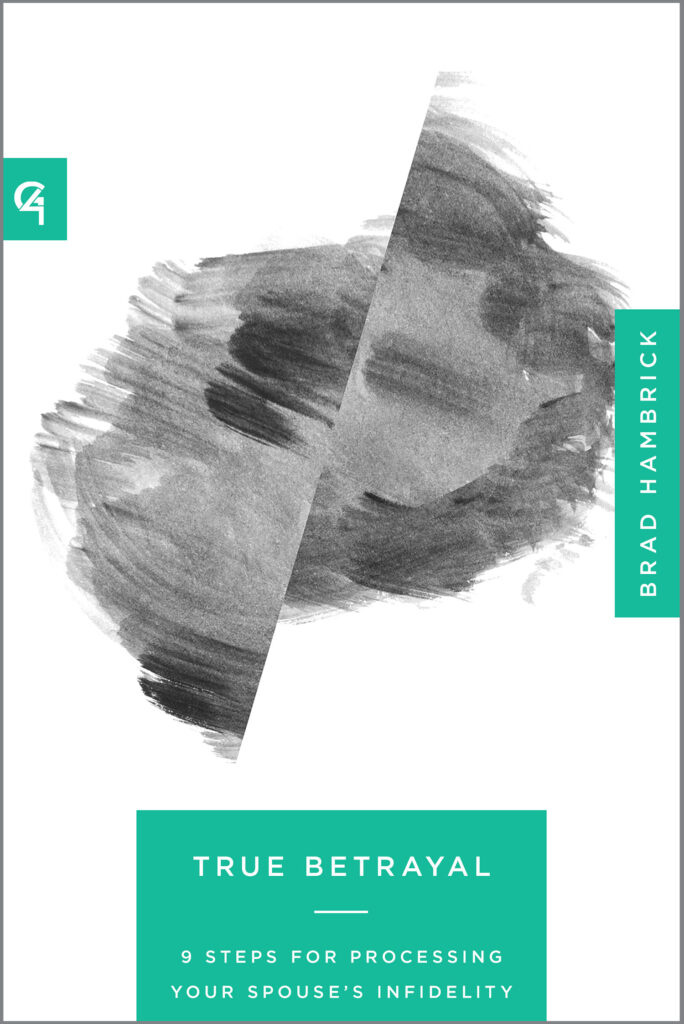
True Betrayal
Finding out about your spouse’s sexual sin feels like a gut punch. In your overwhelming flood of emotions, you may feel like pretending like it never happened or you might think you need to take intense, immediate action. In the middle of your questions and pain, you need a safe, stable place to process what has happened and to take wise steps forward. True Betrayal by counselor and pastor Brad Hambrick outlines a clear, compassionate, and biblical 9-step framework for processing and healing from your spouse’s sexual infidelity.