
On a Sunday afternoon in January 1851, sixteen-year-old Charles Spurgeon was given an opportunity to preach his very first sermon. The only problem was that the service was going to be in less than an hour. If you were in that situation, what would motivate you to take that opportunity? And if you did take it, what would you preach about?
The Motivation for Preaching
The previous day, Spurgeon had agreed to help conduct a worship service in the village of Teversham with a fellow member from his church, St. Andrew’s Street Baptist Chapel in Cambridge. The church had a Preachers’ Association that conducted services out in the farming villages, and the agreement was that the other church member would preach, and Spurgeon would lead in the prayers and singing. But as they walked to the village that Sunday afternoon, they soon discovered that they were both expecting the same thing! Neither had prepared a sermon, and both were expecting the other to preach.
The other man was quite adamant that he was not a preacher, and if Spurgeon was not going to preach, then there would not be a service. What would Spurgeon do? Years later, Spurgeon write about this event,
I walked along quietly, lifting up my soul to God, and it seemed to me that I could surely tell a few poor cottagers of the sweetness and love of Jesus, for I felt them in my own soul. Praying for Divine help, I resolved to make the attempt. My text should be, “Unto you therefore which believe He is precious,” (1 Peter 2:7) and I would trust the Lord to open my mouth in honour of His dear Son. It seemed a great risk and a serious trial; but depending upon the power of the Holy Ghost, I would at least tell out the story of the cross, and not allow the people to go home without a word.
Spurgeon, Autobiography, Vol. 1, 200-201.
Spurgeon decided to not try to expound on the intricacies of covenant theology, the mysteries of God’s sovereignty and human responsibility, the incommunicable attributes of God, or the prophecies of Scripture. He would deal with those themes and passages in future years. But right then, in that moment, Spurgeon would preach on the one thing he knew well: the preciousness of Christ.
At this point, Spurgeon had only been a Christian for about a year. It was only a year ago that he had accidentally stumbled into a Primitive Methodist chapel in the middle of a snowstorm and heard the gospel. There, he encountered the grace of God in Christ, and the burden of his sin was forever removed. Now, a year later, he still had not gotten over God’s grace in rescuing him through his Son. When faced with the opportunity to preach, Spurgeon decided to “tell out the story of the cross” and speak of the “sweetness and love of Jesus” that he felt in his own soul. This was all the motivation he needed for preaching.
The Aim of Preaching
Much to Spurgeon’s surprise, he got through the sermon without breaking down or running out of things to say. He decided to join the Preachers’ Association and give preaching a try, and the rest is history. By the following October, a Baptist church in the village of Waterbeach would call him to be their pastor. And by the spring of 1854, a dying church in London, the New Park Street Chapel, would bring him to the capital of the Victorian empire. From there, this young country preacher would become the Prince of Preachers. His preaching would leave an indelible mark on the 19th century. He would go on to preach thousands of sermons that would be published all around the world.
But through all these changes and new opportunities, the heart of Spurgeon’s preaching remained the same as that very first sermon: he wanted to give people Christ. Eight years later, preaching to a congregation of 10,000 at the Royal Gardens Music Hall in London, Spurgeon decided to once again take as his text 1 Peter 2:7. This was a far cry from the few farmers in the cottage in Teversham. But the subject was the same.
It’s here in this sermon that we hear Spurgeon’s famous illustration of his approach to preaching.
Christians are all agreed, that the best sermon is that which is fullest of Christ. They never like to hear a sermon unless there is something of Christ in it. A Welsh minister who was preaching last Sabbath at the chapel of my dear brother, Jonathan George, was saying, that Christ was the sum and substance of the gospel, and he broke out into this story—A young man had been preaching in the presence of a venerable divine, and after he had done he went to the old minister, and said, “What do you think of my sermon?” “A very poor sermon indeed,” said he. “A poor sermon?” said the young man, “it took me a long time to study it.” “Ay, no doubt of it.”
Spurgeon, New Park Street Pulpit, Vol. 5, 140.
“Why, did you not think my explanation of the text a very good one?” “Oh yes,” said the old preacher, “very good indeed.” “Well, then, why do you say it is a poor sermon? Didn’t you think the metaphors were appropriate and the arguments conclusive?” “Yes, they were very good as far as that goes, but still it was a very poor sermon.” “Will you tell me why you think it a poor sermon?” “Because,” said he, “there was no Christ in it.” “Well,” said the young man, “Christ was not in the text; we are not to be preaching Christ always, we must preach what is in the text.” So the old man said, “Don’t you know young man that from every town, and every village, and every little hamlet in England, wherever it may be, there is a road to London?” “Yes,” said the young man. “Ah!” said the old divine “and so from every text in Scripture, there is a road to the metropolis of the Scriptures, that is Christ. And my dear brother, your business is when you get to a text, to say, ‘Now what is the road to Christ?’ and then preach a sermon, running along the road towards the great metropolis—Christ. And,” said he, “I have never yet found a text that had not got a road to Christ in it, and if I ever do find one that has not a road to Christ in it, I will make one. I will go over hedge and ditch but I would get at my Master, for the sermon cannot do any good unless there is a savor of Christ in it.”
For Spurgeon, this was the motivation that propelled his preaching: He longed to give people Christ. As one who had experienced the preciousness of Christ, he wanted others to know Christ also. He was willing to “go over hedge and ditch,” to get at his Master and to give his people a taste. This is not to say that his preaching was ever simplistic or repetitive. He expounded the whole counsel of Scripture, preaching thousands of sermons on every theological subject, from every book of the Bible. But rising above the landscape of the Bible was the great metropolis of Christ. As all roads lead to London, so all texts (and their sermons) must lead to Christ.
For Spurgeon, Christ was both his motivation and his aim in preaching. This was the hallmark of his ministry, and so must it be for all faithful preachers of God’s Word today.
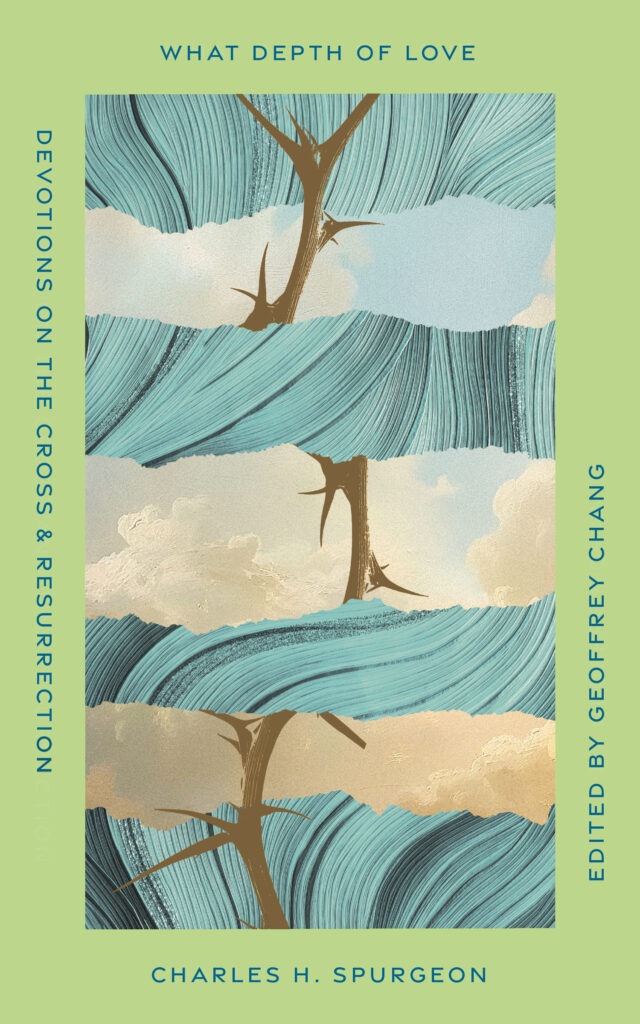
What Depth of Love
This Easter season, meditate deeply on Christ’s final moments before his death and his triumphant resurrection with forty devotions taken from the sermons of Charles H. Spurgeon. Compiled by Geoffrey Chang, curator of the Spurgeon Library at Midwestern Baptist Theological Seminary.